Printable Kick Count Chart for Daily Baby Movement Tracking
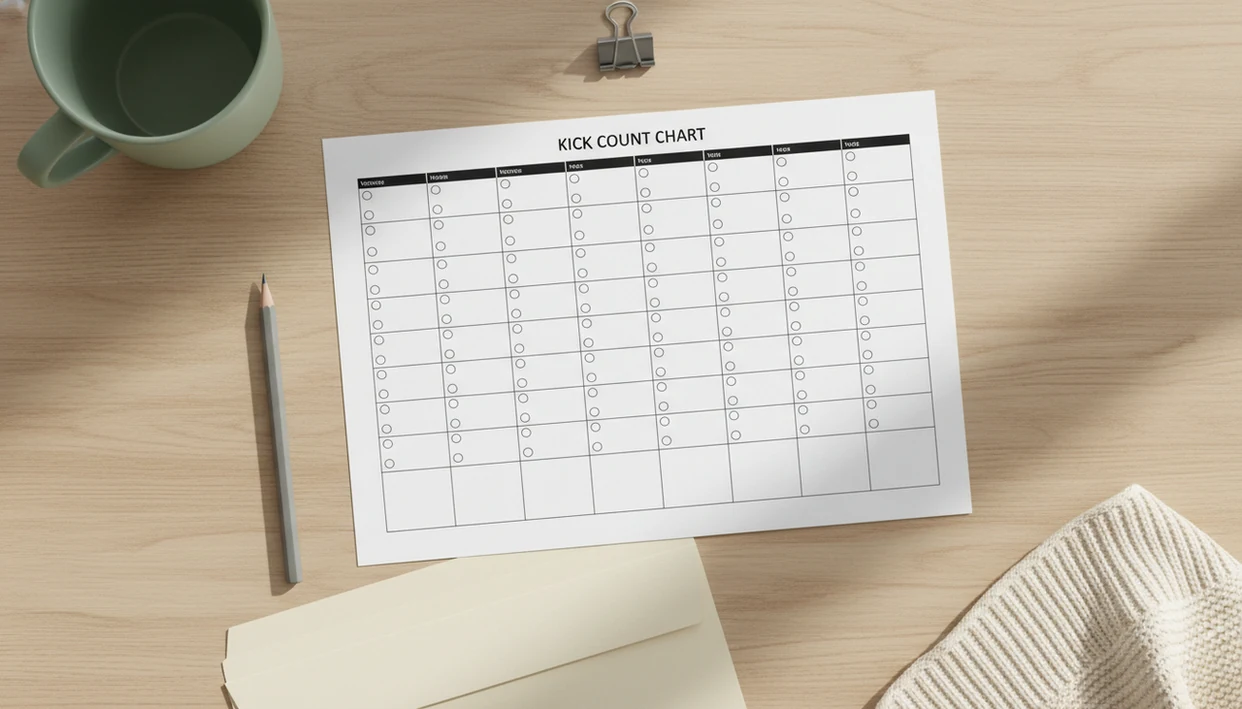
A printable kick count chart is a paper log for recording your baby’s movements, the start time, the time it takes to reach your provider’s target count, and any notes about strength or pattern changes. A printable kick count chart works best in the third trimester as a backup to an app or as a simple sheet to bring to appointments.
A printable kick count chart is a paper or PDF baby movement log used in late pregnancy to track repeated fetal movement sessions and notice changes from the baby’s usual pattern.
- Most kick count printables track the date, start time, movement count, total time, movement strength, and notes.
- Common methods include 10 movements within 2 hours, 6 movements within 2 hours, or 5 movements in 30 minutes, depending on provider instructions.
- A paper chart is a tracking aid, not a diagnosis, so reduced or unusual movement should be reported to your care team.
Printable Kick Count Chart Fields to Include
A useful printable kick count chart records the same details every day: date, gestational week, start time, end time, movement count, time to target, movement strength, position, and notes. That structure makes the sheet easier to read during a call or appointment.
Movements may include kicks, rolls, flutters, swishes, stretches, twists, or tiny pops unless your provider gives different instructions. Hiccups are often logged separately because they can feel rhythmic but are not always counted the same way as fetal movements.
The notes box matters. Write down what changed, such as “slower than usual after dinner” or “strong rolls on left side.” A printable is handy in a folder beside blood pressure notes, but it does not replace urgent medical advice if movement feels reduced or unusual. For broader templates, our kick count charts and logs guide compares common log formats.
Kick Count Printable Setup Rules at 28 Weeks
Fetal movement counting is commonly used in the third trimester, and some patient materials advise daily counting from about 28 weeks if your provider recommends it. Alberta Health Services gives 28 weeks as a starting point in its patient handout source.
- Start with your provider’s timing. Some people begin around 28 weeks, but high-risk monitoring may use different instructions.
- Pick an active window. Choose a time when your baby usually moves, such as after dinner or before bed.
- Use the same setup. Sit or lie quietly, reduce distractions, and keep the chart in one place.
- Write the method on the page. Thresholds vary, so copy the clinician’s exact target onto the printable.
- Keep the routine boring. Same time, same place, same sheet. That is the point.
A phone timer beside a water glass can help even if the final record is paper.
How a Printable Kick Count Chart Works
A printable kick count chart works by creating a repeated baseline, not by judging one movement session in isolation. You record when counting starts, count movements until the target is reached, then compare the total time with your baby’s usual movement pattern.
The mechanism is simple pattern tracking. In clinical language, the chart supports “fetal movement awareness,” which means noticing meaningful changes from the baby’s normal activity. Common handout methods include 10 movements within 2 hours, 6 movements within 2 hours, or 5 movements in 30 minutes. Those are examples, not one universal rule.
The most common medically supported way to use kick counts is a consistent daily session combined with clear instructions for when to call your care team. A normal-looking chart should never be used to prove everything is fine if your instincts or symptoms say something has changed.
How to Use a Printable Kick Count Chart in 6 Steps
Use the chart during a quiet movement session, then write down enough detail that your care team can understand what happened later. If movement is reduced, unusual, or below your instructed threshold, call your provider rather than waiting for tomorrow’s count.
- Set the routine. Choose the baby’s usual active time and use roughly the same position each day.
- Start the timer. Write the start time before you begin counting.
- Count each movement. Mark kicks, rolls, flutters, swishes, or twists unless your provider says otherwise.
- Stop at the target. Record the end time when you reach the instructed number.
- Record notes. Add strength, position, distractions, and anything that felt different.
- Review changes. Compare today with recent sessions and contact your care team for reduced or unusual movement.
For people who misplace paper, a daily kick count log can keep the same routine in a more organized format.
Baby Movement Chart PDF Thresholds to Confirm
A baby movement chart PDF should show the action threshold clearly, because fetal movement handouts do not all use the same target. Write your provider’s exact instructions at the top or bottom before you use the chart.
| Common method | What the chart tracks | Important note |
|---|---|---|
| 10 movements in 2 hours | Time needed to reach 10 movements | Cleveland Clinic describes this as a common standard during the baby’s active time source. |
| 6 movements in 2 hours | Whether 6 movements happen within the window | Used in some hospital and patient-education materials; Alberta Health Services describes calling if fewer than 6 movements are felt within 2 hours source. |
| 5 movements in 30 minutes | Whether 5 movements happen in a shorter active window | Described in some patient handouts, including Northwestern Medicine materials source. |
For a printed sheet, the action line should be impossible to miss. Something like “Call if fewer than __ movements in __ minutes” is clearer than small text buried under the notes box.
When to Call Your Care Team About Baby Movement
Call your care team promptly if your baby’s movement is reduced, unusual, or clearly different from their normal pattern. If it feels wrong today, do not wait for tomorrow’s chart or the next routine counting session.
Use the threshold your clinician or hospital gave you, even if a printable shows a different example. The chart helps you explain the timeline, but it cannot diagnose a problem or prove everything is fine.
- Call the maternity unit, triage line, midwife, or provider number listed in your instructions when movement is below the written threshold or feels noticeably changed.
- Describe what is different in plain language, such as fewer movements, weaker rolls, a longer quiet spell, or a pattern that does not match the usual active time.
- Mention any other symptoms right away, including bleeding, pain, dizziness, contractions, fever, or fluid leaking from the vagina.
- Share the dated chart if you have it nearby, including the start time, end time, count, and notes.
- Follow the next instruction you are given, whether that means continued monitoring, coming in for assessment, or calling emergency services.
Printable Kick Count Chart Mistakes to Avoid
The biggest paper-log mistakes make sessions hard to compare or delay a needed call. A crumpled notebook page at the bottom of a purse is better than nothing, but it is not a reliable system.
- Random-time counting. Counting at 9 a.m. one day and midnight the next makes patterns harder to judge.
- Distracted counting. Heavy multitasking can mean missed rolls, swishes, or quieter stretches.
- One-day reassurance. Stopping after one normal session misses the point of repeated third-trimester tracking.
- Wrong conclusion from one session. A missed target is not proof of a problem or proof of safety; follow your clinician’s call instructions.
- Scattered pages. Loose sheets without dates can confuse the timeline when you need to explain a change.
For appointment prep, it helps to share kick logs with doctor in a dated format rather than describing several days from memory.
Paper Kick Count Printable vs App Tracking
Paper works well for appointments, low battery days, phone-free routines, printer-friendly backups, or handing a sheet to a support partner. An app helps with reminders, timestamps, saved history, fewer lost logs, and easier pattern review.
| Method | Works well for | Main drawback |
|---|---|---|
| Paper printable | Simple routines, hospital bags, partner sharing, appointment folders | Can be lost, damaged, or forgotten |
| App tracking | Reminders, timestamps, history, pattern review | Requires a charged phone and consistent use |
| Both together | Paper backup plus organized digital history | Takes a little more setup |
Baby Kicks App is a baby kick counter app that helps pregnant people count kicks, track movement patterns, and know when to call their provider. A good fetal kick counter and pregnancy movement tracking app for third-trimester monitoring delivers organized movement history and clearer routines, not a diagnosis or permission to ignore reduced movement.
Use the method you can repeat consistently. Tools like Baby Kicks App can also help you export fetal movement logs if paper keeps disappearing.
Limitations
A printable chart is useful, but it has real limits. It should support a conversation with your care team, not replace one.
- A printable chart does not diagnose fetal distress or rule out pregnancy complications.
- Different clinicians, clinics, and hospitals may use different movement thresholds.
- Normal fetal sleep cycles can cause temporary lulls in movement.
- Distracted counting can miss softer movements and reduce accuracy.
- Paper logs can be forgotten, misread, damaged, or lost.
- A chart may not show movement strength clearly unless you write notes each time.
- Any significant decrease, unusual pattern, or concern should prompt contacting the care team now, not waiting for the next routine session.
Clinicians typically recommend following your own provider’s instructions for fetal movement counting because thresholds and risk factors vary. If the pattern feels wrong, call.
FAQ
When should I start kick counts?
Many resources start daily kick counting around 28 weeks, but you should follow your provider’s timing. Some pregnancies need different monitoring instructions.
What counts as baby movement?
Kicks, rolls, flutters, swishes, stretches, and twists may count unless your care team gives different instructions. Use the same definition each time you complete the chart.
Do hiccups count as kicks?
Hiccups are usually treated differently from fetal movements. If you notice hiccup taps in a steady rhythm, log them separately unless your provider says otherwise.
How many kicks are normal?
Normal depends on the counting method and your baby’s usual pattern. Common thresholds include 10 in 2 hours, 6 in 2 hours, or 5 in 30 minutes.
What should I do if I get fewer kicks than usual?
Contact your care team promptly if movements are reduced, unusual, or below the threshold they gave you. Do not wait for the next routine session if you are concerned.
Can I use a paper kick count chart instead of an app?
Yes, a paper chart can work well as a backup or appointment log if you complete it consistently. Keep it dated and bring it when you discuss movement changes.
Is an app better than a paper kick count chart?
A kick counter app may be easier for reminders, timestamps, and saved history. Paper may be better for simple sharing, phone-free routines, or a printed backup.