Daily Kick Count Log for Third-Trimester Fetal Movement Tracking
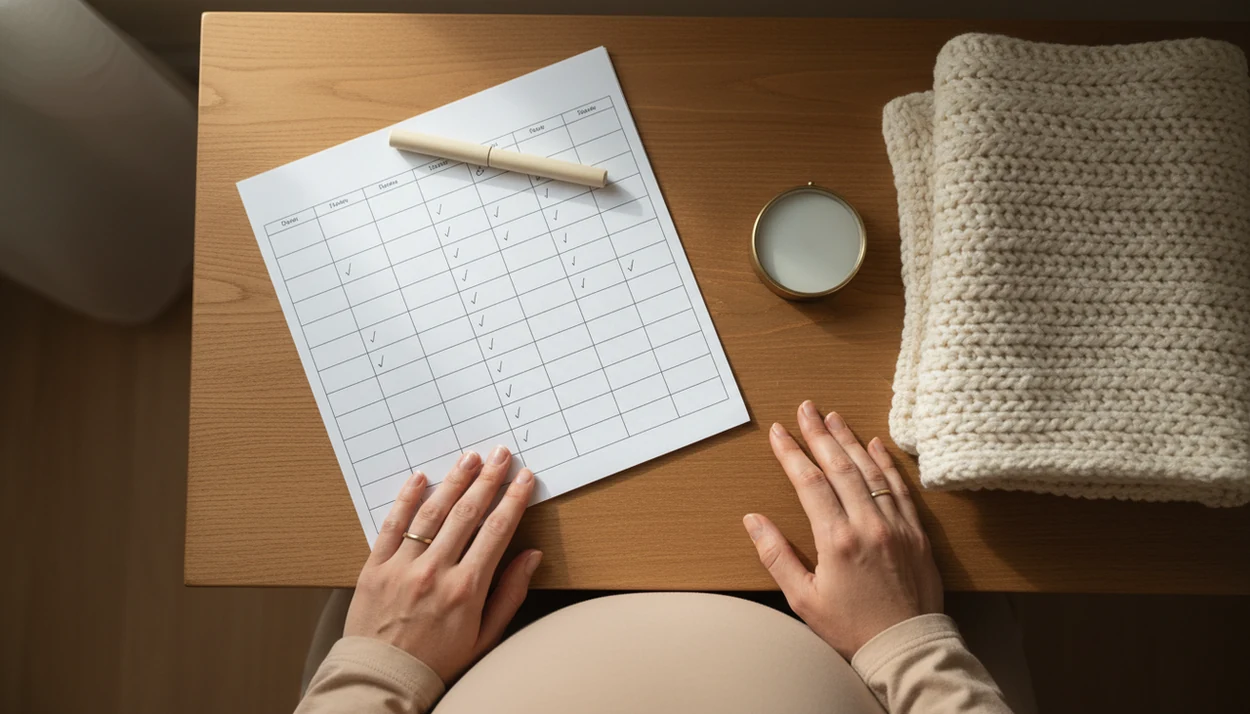
A daily kick count log is a simple record of when you counted your baby’s movements, how many you felt, how long it took, and whether anything felt different from your baby’s usual pattern. Use it at about the same time each day in the third trimester, and contact your provider promptly if movements are reduced, weaker, unusually different, or concerning.
> Definition: A daily fetal movement log is a third-trimester tracking record that captures fetal movement sessions so pregnant people can recognize their baby’s usual pattern and discuss changes with their provider.
- Record the date, start time, end time, movement count, movement strength, and any unusual notes.
- Most people begin daily kick counting around 28 weeks, or earlier if their provider recommends it.
- A common benchmark is 10 movements within up to 2 hours, but a noticeable change from your baby’s normal pattern matters too.
Daily kick count log essentials at a glance
A daily kick count log is a repeatable record of one movement session, usually done once a day in the third trimester. The useful fields are date, start time, end time, total movements, movement strength, and notes about anything unusual.
The point is not to compare your baby with a friend’s baby. It is to learn your baby’s usual movement pattern, then notice when that pattern changes. A folded kick count handout in a hospital bag can help, but it is easy to forget details after a long day.
Tools like Baby Kicks App can help pregnant people count kicks, track movement patterns, and know when to call their provider. A good fetal kick counter and pregnancy movement tracking app for third-trimester monitoring delivers organized observations, not a diagnosis or guaranteed reassurance.
Five facts about a daily fetal movement log
- Most people start a daily fetal movement log around 28 weeks, unless their provider recommends earlier tracking because of a specific pregnancy risk.
- Kicks are not the only movements that count; rolls, jabs, wiggles, stretches, swishes, and clear flutters can all be recorded.
- A common method is to count until 10 movements, then write down how long that movement session took.
- Your baby’s usual rhythm is the reference point, so a side-lying count after dinner may be more useful than random checks all day.
- Reduced fetal movement is associated with higher stillbirth risk and should be taken seriously; one Norwegian case-control study found about 2.4-fold higher odds of stillbirth among women reporting decreased fetal movement (Frøen et al., BMC Pregnancy and Childbirth: https://bmcpregnancychildbirth.biomedcentral.com/articles/10.1186/1471-2393-4-2).
Clinicians typically recommend contacting your maternity care team promptly when fetal movement is reduced or clearly different from normal. Don’t wait for tomorrow’s log entry.
Daily kick count log fields to include before you start
A pregnancy kick log should capture the same core details each day so changes are easier to see and easier to explain.
Use these fields before you begin: date, gestational week, start time, end time, total movement count, and movement quality. Movement quality can be simple words like flutter, roll, jab, wiggle, stretch, or strong kick. Add context notes too. Write down meals, rest, position, distractions, illness, stress, or anything that made the session unusual.
Tiny pops below the belly button count if they are distinct movements.
If your provider gives you a custom threshold, record it at the top of the log. That may be more useful than a generic chart. If you prefer paper, a printable kick count chart can keep the fields consistent without making the process feel medical every night.
How a pregnancy kick log works
A pregnancy kick log works by turning a subjective impression, “baby feels quieter,” into repeated observations. The light technical idea is a baseline: your baby’s normal range of timing, frequency, and movement quality over days and weeks.
Consistent timing reduces noise in the data. Counting in the same chair after dinner, with a phone timer open, gives a cleaner comparison than counting during a meeting one day and during errands the next. Habit loops help here. Same time, same place, same prompt.
Trends matter more than one tidy number. If sessions usually take 18 minutes and then take 80 minutes with weaker rolls, that is worth discussing. The most common medically supported way to use kick counts is daily pattern awareness combined with prompt provider contact when movement changes.
A log supports clinical conversations. It does not diagnose fetal health.
How to use a daily kick count log
Use a daily kick count log when your baby is usually active and when you can pay attention without rushing. A 9 p.m. phone alert after brushing teeth works better for many people than hoping they remember before sleep.
- Set a daily time when your baby is usually active, such as after dinner or before bed.
- Sit or lie on your side and reduce distractions, even if that only means lowering the TV volume.
- Count each distinct movement including kicks, rolls, jabs, wiggles, stretches, and swishes.
- Stop at the goal your provider gave you, commonly 10 movements, unless they told you a different plan.
- Log the details including time, count, strength, position, and anything unusual.
- Call your provider if movements are reduced, weaker, suddenly different, or worrying.
For urgent safety wording, NHS guidance says to contact your midwife or maternity unit immediately if your baby’s movements slow down, stop, or change (https://www.nhs.uk/pregnancy/keeping-well/your-babys-movements/).
For many people, a daily kick count log usually works best when it is tied to an existing routine, while scattered counting fits poorly with pattern tracking.
Normal daily fetal movement count versus concerning changes
“What is a normal daily fetal movement count?” Normal depends on your baby’s baseline, not a universal number that applies to every pregnancy.
A commonly used threshold is at least 10 fetal movements in up to 2 hours when you are concerned about reduced movement; ACOG describes this as one common fetal movement-counting method (https://www.acog.org/clinical/clinical-guidance/committee-opinion/articles/2021/06/indications-for-outpatient-antenatal-fetal-surveillance). Still, reaching 10 does not automatically override a clear change from your baby’s normal pattern. If your baby usually reaches 10 in 20 minutes and suddenly takes nearly two hours, write down what changed and call your care team.
Concerning changes include suddenly taking much longer, fewer movements, weaker jabs, softer rolls, or a sudden significant pattern change. A triage bracelet after reduced movement is not a failure of logging. It is the log doing its job by helping you act sooner.
If you are worried, contact your provider rather than waiting to complete another session.
Paper daily fetal movement log versus kick counter app
Paper logs and kick counter apps can both work if you use them consistently. Choose the method you will actually use daily, not the one that looks nicest in theory.
| Method | What it does well | Where it can fall short |
|---|---|---|
| Paper log | Simple, printable, low-tech, easy to tuck into a folder | Can get lost, skipped, or hard to summarize |
| Kick counter app | Timers, reminders, averages, and trend views reduce friction | Still depends on accurate taps and honest notes |
| App graph | Makes movement history easier to show in triage or visits | A graph cannot interpret fetal health |
| Mixed method | Gives backup if one system fails | Duplicate entries can become confusing |
A crumpled notebook page at the bottom of a purse is common. If sharing matters, app histories or tools that export fetal movement logs may be easier to bring into appointments.
Daily kick count log mistakes that create false reassurance
Some kick count habits make the log less useful or more anxiety-provoking. Watch for these common problems before they become your routine.
- Random-session counting: Counting at different times every day without notes makes patterns harder to compare.
- Strength-blind logging: Recording only “10” misses useful details, such as flutters replacing strong jabs.
- The 10-movement trap: Assuming 10 movements always means everything is fine can delay needed care.
- Comparison counting: Your friend’s baby may be active at midnight; yours may not be.
- Care replacement: A log is not prenatal care, ultrasound, nonstress testing, or provider evaluation.
Waiting too long is the mistake we worry about most. If movement feels clearly different, call. A partner holding the call script can help when you’re trying to explain dates, times, and what changed. For broader safety questions, the guide on are kick counter apps safe covers what apps can and cannot do.
Daily fetal movement log review with your provider
A daily fetal movement log is most useful when it helps your provider see the pattern quickly. Review several days or weeks of entries for baseline timing, usual strength, and the sessions that stood out.
Do not expect your provider to scan every normal entry during a short visit. Highlight the unusual ones: “usually 15 to 25 minutes after dinner, then 70 minutes on Tuesday with weaker rolls.” That sentence is more useful than handing over a full notebook without context.
Ask what threshold your provider wants you to use. Some teams follow the common 10 movements in up to 2 hours benchmark. Others may give different instructions based on your pregnancy.
Bring the paper log, screenshot, or app history to visits or triage. If you need help preparing, share kick logs with doctor explains what details are worth sending. Urgent concerns should be called in immediately, not saved for the next appointment.
Medical sources for daily fetal movement tracking
Medical sources treat daily fetal movement tracking as an awareness habit, not a home test that proves fetal wellbeing. The safest pattern is to count consistently, notice change, and contact your own maternity team when something feels off.
- Use ACOG’s framing as a general reference: one common method is counting until 10 movements within up to 2 hours, especially when you are checking a concern, but evaluation may still be needed when movement is reduced or different.
- Call promptly if movements slow, stop, weaken, or change from your baby’s usual pattern; NHS and RCOG-style advice emphasizes not waiting until the next day.
- Treat kick counts as observations for conversation, not a diagnosis, ultrasound, nonstress test, or guarantee that everything is fine.
- Recognize the reduced-movement risk statistic as coming from the Norwegian case-control study by Frøen and colleagues in BMC Pregnancy and Childbirth, which linked reported decreased fetal movement with higher odds of stillbirth.
- Follow your local provider’s instructions first. If their threshold, timing, or triage advice differs from general online guidance, use their plan.
Limitations
A daily kick count log is an awareness tool, not a safety guarantee. It can support better conversations, but it cannot remove every risk in late pregnancy.
- A log cannot prevent all stillbirths or pregnancy complications.
- Formal kick-counting research and recommendations vary by provider, hospital, and region.
- An anterior placenta, higher BMI, busy schedules, and distraction can make movements harder to notice.
- Missed days or changing methods reduce the usefulness of trend comparisons.
- The log may increase anxiety for some people, especially after one slower session.
- It may create false reassurance if concerning changes are ignored because the count reached 10.
- Kick counting does not replace prenatal visits, ultrasound, nonstress testing, or provider evaluation.
Tools such as Baby Kicks App, Count the Kicks, and paper charts can organize movement sessions, but none can tell you that everything is definitely fine. If your provider’s instructions differ from a general pregnancy kick log, follow your provider.
FAQ
When should kick counts start?
Many people start kick counts around 28 weeks of pregnancy. Your provider may recommend starting earlier if you have a higher-risk pregnancy or specific monitoring plan.
What counts as a kick?
Kicks, rolls, jabs, wiggles, stretches, swishes, and other distinct fetal movements can count. Use the same definition each day so your log stays consistent.
How long should kick counts take?
A common benchmark is 10 movements in up to 2 hours when concerned. Your own baby’s usual timing is also important.
Should I count hiccups?
Rhythmic hiccups are often tracked separately from distinct movements. Ask your provider whether they want hiccups included in your log.
What if kicks feel weaker?
Contact your provider promptly if movements feel noticeably weaker or different from your baby’s usual pattern. Do not rely on another session to rule out concern.
Can babies have quiet days?
Babies can have normal variation in activity. A clear reduction, weaker movement, or concerning pattern change should still be discussed with your provider.
Is a kick count app accurate?
A kick count app is only as accurate as the movements you enter. Use it to organize timing, notes, and trends; do not treat it as an interpretation of fetal health.
Does kick counting replace monitoring?
No. Kick counting supports awareness but does not replace prenatal care, ultrasound, nonstress testing, triage evaluation, or your provider’s instructions.