Kick Counting With Anterior Placenta in Late Pregnancy
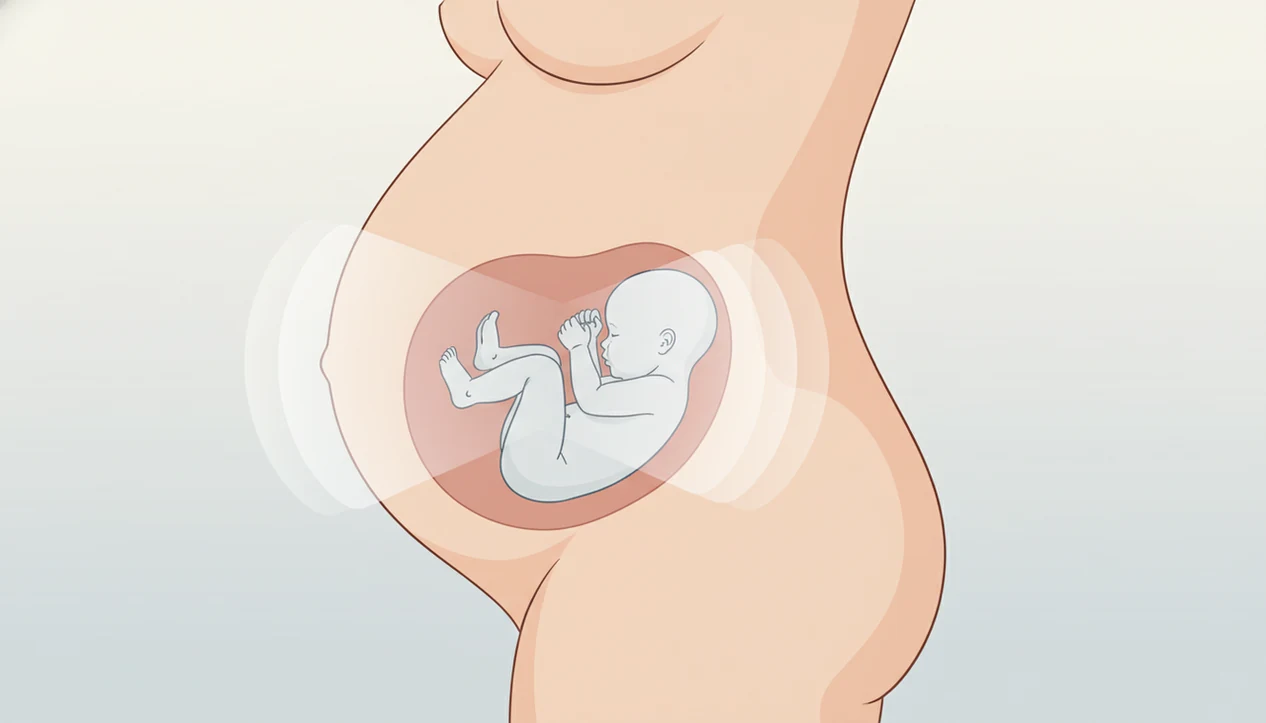
Kick counting with anterior placenta is still useful in late pregnancy, but movements may feel softer, lower, or more to the sides because the placenta cushions the front of the uterus. Track your baby’s usual daily pattern, and call your provider urgently if movements are reduced, changed, or do not reach your provider’s threshold.
Definition: An anterior placenta sits on the front wall of the uterus, which can muffle how baby movements feel without necessarily meaning the baby is moving less.
TL;DR
- An anterior placenta can make kicks feel lighter, later, or more side-to-side, especially before the third trimester.
- Most pregnant people can still track a reliable movement pattern by around 28 weeks using a consistent daily kick-count routine.
- Do not blame reduced movement on the placenta; a noticeable change after 28 weeks should prompt an urgent call to your healthcare provider.
Anterior Placenta Baby Movement: What Feels Different
An anterior placenta sits between the baby and the front of your belly, so it can cushion movements that would otherwise feel sharp or obvious. It changes what you feel, not necessarily how much your baby moves.
Instead of front-belly jabs, anterior placenta baby movement may feel like rolls, nudges, low pressure, side kicks, or internal shifting. Some people describe a soft swish after changing sides. Others notice rolling pressure under the right ribs but very little in the center of the belly.
You may also feel first movements later than a friend whose placenta is posterior or fundal. That comparison can be frustrating. Still, by the third trimester, most pregnant people can learn their baby’s usual movement pattern through repeated counts at the same time of day.
The key is not force. It’s consistency.
Kick Counting With Anterior Placenta: Five Facts That Matter
- You can still do kick counts with an anterior placenta. The placenta may muffle sensation, but movement patterns are usually trackable in late pregnancy.
- Research suggests count times can be similar from about 24 weeks onward. Studies comparing placenta positions have found that the time to reach 10 movements may not differ much after this point. For general fetal movement guidance, ACOG notes that kick counting is commonly done by timing how long it takes to feel 10 movements, while emphasizing provider-specific instructions: source.
- Daily counting is often started around 28 weeks. Clinicians typically recommend asking your own maternity team when to begin, especially if you have risk factors or different instructions.
- Your baby’s usual pattern matters more than someone else’s kick strength. For anterior placenta kick counts, a soft roll that happens daily may be more useful than comparing strong jabs with another pregnancy.
- Reduced or changed movement should not be dismissed as the placenta. A clear change after 28 weeks needs an urgent call, even if movements have always felt cushioned.
Anterior Placenta Kick Counts Before You Start
Before beginning anterior placenta kick counts, ask your provider when they want you to start and what threshold they use. Many routine daily kick count plans begin around 28 weeks, but your provider’s instructions come first.
Choose a time when your baby is usually active. For some people, that is after dinner with a phone timer open on the couch. For others, it is a quiet late-morning session after walking around the house. Use a timer, paper chart, or fetal movement app, whichever you will actually keep using.
Count all distinct movements. Kicks count, but so do rolls, flutters, nudges, jabs, swishes, and stretches. A folded handout in a hospital bag is helpful, but a crumpled notebook page at the bottom of a purse is easy to lose. If paper works for you, kick count charts and logs can keep the routine simple.
How Kick Counting With Anterior Placenta Works
Kick counting is a pattern-tracking routine, not a diagnostic test. The usual method records how long it takes to feel a set number of distinct movements, often 10, during a focused movement session.
With an anterior placenta, sensation can be dampened because the placenta cushions movement toward the front of the uterus. Repeated counting helps build a personal baseline, which is the normal range for your baby, not a universal score. That baseline is useful because change is often more important than one isolated soft movement.
A good fetal kick counter and pregnancy movement tracking app for third-trimester monitoring delivers organized time-to-10 logs and trend notes, not a diagnosis or permission to ignore a concern.
A simple log or app can show trends over days instead of asking you to remember last Tuesday’s count while exam room paper crinkles underneath. If you use Baby Kicks App, treat it as an organized record for your provider conversation, not as a medical assessment.
How to Use Anterior Placenta Kick Counts Each Day
For anterior placenta kick counts, use the same daily setup so softer movements are easier to recognize over time. The most common medically supported way to track fetal movement is a focused daily count combined with prompt reporting of reduced or changed movement.
- Set a daily count time when your baby is usually awake or active.
- Sit comfortably or lie on your left side and focus on movement without distractions.
- Log every distinct kick, roll, flutter, nudge, jab, or stretch rather than waiting only for hard kicks.
- Stop when you reach your provider’s target, commonly 10 movements within up to 2 hours.
- Review the time-to-10 trend over several days rather than judging one soft movement.
- Call your provider if today’s pattern is clearly slower, weaker, or different.
A 9 p.m. phone alert after brushing teeth works well for many people because the routine is already anchored. Small habits stick.
Building a Baseline for Anterior Placenta Baby Movement
Anterior placenta users may need to log softer movement types more carefully because the clearest pattern may be time, location, and repetition rather than kick strength. A movement log can record time-to-10, body position, time of day, and notes like “mostly low nudges” or “left-side rolls.”
That kind of log can separate a quiet-feeling baby from a changed pattern. If your usual count takes 18 minutes after dinner, a sudden 90-minute session with weaker movement is worth reporting. The app data supports that conversation, but it does not replace clinical assessment.
For anterior placenta pregnancies, a consistent time-to-10 log is often easier than judging kick strength because the placenta can make strong and weak movements feel closer together.
A Fetal Kick Tracker is most useful when it reflects real sessions, not half-remembered taps added later. If a reminder is missed after an appointment, restart at the next usual count time.
Quiet-Day Troubleshooting for Anterior Placenta Kick Counts
“Why is my anterior placenta baby movement hard to feel today?” Start a focused count instead of casually waiting all day. A focused session gives you a clearer answer than checking between errands, messages, and appointments.
Try lying on your left side, choosing a quiet room, drinking water, and paying attention to subtle rolls or nudges. Some people notice movement only after the room gets still. Pillow wedged under one hip, timer open, no scrolling. That setup makes faint movement easier to notice.
Do not use home tricks as a reason to delay care if movement is reduced. If the count is not reassuring, you cannot reach your provider’s target, or the pattern feels clearly different, call your provider or labor and delivery promptly.
Anterior placenta can explain muffled sensation. It should not be used as reassurance when today’s pattern is not your baby’s usual pattern.
Common Mistakes With Kick Counting and Anterior Placenta
One common mistake is assuming kick counts do not apply because the placenta is in front. They still apply for most third-trimester pregnancies, though your provider may adjust instructions for your situation.
Another mistake is counting only hard kicks. With an anterior placenta, a stretch, roll, swish, or side nudge may be one of your baby’s normal movements. Ignoring those can make the count look slower than it really is.
It is also a mistake to expect movement to slow down near the due date. Movements may feel more cramped or rolling as space changes, but they should not steadily decrease just because birth is closer.
Comparing your baby’s kick strength with another pregnancy can add noise. Your job is to notice your baby’s usual movement pattern. If you have twins, growth restriction, diabetes, or another risk factor, ask about individualized guidance, such as a kick counter for high-risk pregnancy.
When Reduced Anterior Placenta Baby Movement Needs a Call
Call urgently for a noticeable decrease in frequency, strength, or pattern after 28 weeks. Also call if you cannot reach the movement goal your provider gave you, or if movement feels suddenly absent, much weaker, or clearly different.
Most decreased-movement visits may have normal outcomes, but some do not. In a large Norwegian study of people presenting with decreased fetal movement, 64% had a normal pregnancy outcome, while 4.4% experienced a stillbirth, according to the study abstract source. That is why reduced movement is taken seriously even when many checks are reassuring.
Kick counting flags changes; clinicians assess fetal wellbeing. They may use monitoring, ultrasound, or other tests depending on your pregnancy and symptoms. If you have a condition like gestational diabetes, your care plan may include different movement instructions, and kick counting with gestational diabetes may need closer provider input.
Medical Scope and Source Notes for Anterior Placenta Kick Counting
This guide is general education about anterior placenta kick counting, not individualized medical advice. Your own care team’s instructions come first, especially if your pregnancy has any added risk factors.
The approach here is framed around provider-directed movement monitoring, ACOG-style fetal movement guidance, and research on reduced fetal movement. Common routines often use “time to 10 movements,” but hospitals and maternity units may use different thresholds, call-in rules, or same-day assessment pathways. A softer anterior-placenta pattern can still be normal for you, but a changed pattern needs attention.
- Follow the counting start date, target, and call threshold your provider gives you.
- Ask whether your hospital wants you to call after a specific time, a missed target, or any noticeable change.
- Confirm an individualized plan if you have twins, growth concerns, diabetes, hypertension, previous loss, reduced fluid, or any other high-risk factor.
- Use kick counts as a record of movement patterns, not as proof that everything is medically fine.
- Call your provider, triage line, or labor and delivery urgently for reduced, absent, weaker, or clearly different movement.
Limitations
Kick counting is useful, but it has real limits. It helps you notice changes in movement, not explain why those changes are happening.
- Kick counting cannot diagnose the cause of reduced, absent, or unusual movement.
- There is no single perfect number of movements per hour that fits every pregnancy.
- An anterior placenta can delay the point when a clear baseline is easy to recognize.
- App-based logs depend on consistent use and accurate entries.
- A normal count does not replace provider advice if your intuition says something is wrong.
- People with high-risk pregnancies may need individualized monitoring beyond kick counts.
- Movement quality can be harder to describe than movement frequency.
- Twins can be harder to track separately, so ask for specific instructions or read about a kick counter for twins if that applies.
Daily movement awareness matters because stillbirth remains a serious pregnancy outcome. ACOG reports that about 1 in 160 pregnancies in the United States ends in stillbirth at 20 weeks or later source.
FAQ
Can I still count kicks with an anterior placenta?
Yes. Kick counting is still appropriate with an anterior placenta, especially in the third trimester when a usual movement pattern is usually easier to recognize.
When should I start kick counting with an anterior placenta?
Many providers recommend starting daily kick counts around 28 weeks unless they give different instructions. Ask your provider what timing and threshold they want you to use.
Do anterior placentas hide baby kicks?
An anterior placenta can cushion sensations and make movement feel softer, lower, or more off to the sides. It does not necessarily mean movement is absent.
Does an anterior placenta mean my baby moves less?
Usually, no. The baby may be moving normally, but the placenta can change how strongly or where you feel movement.
What counts as fetal movement during kick counts?
Count distinct kicks, rolls, nudges, swishes, stretches, flutters, and jabs. Do not count hiccups unless your provider specifically tells you to.
Is 10 movements within 2 hours enough?
Many routines use 10 movements within up to 2 hours, but your provider’s instructions and your baby’s usual pattern matter most. Call if the count is slower or different than normal.
Should baby movements slow down near birth?
No. Movements may feel different near birth, but they should not clearly decrease just because the due date is close.
When should I call my provider about reduced movement?
Call urgently for reduced, absent, weaker, or clearly changed movement patterns. Do not wait for the next appointment if today’s movement feels wrong.