Kick Counter For Twins: Movement Tracking Limits And Provider Guidance
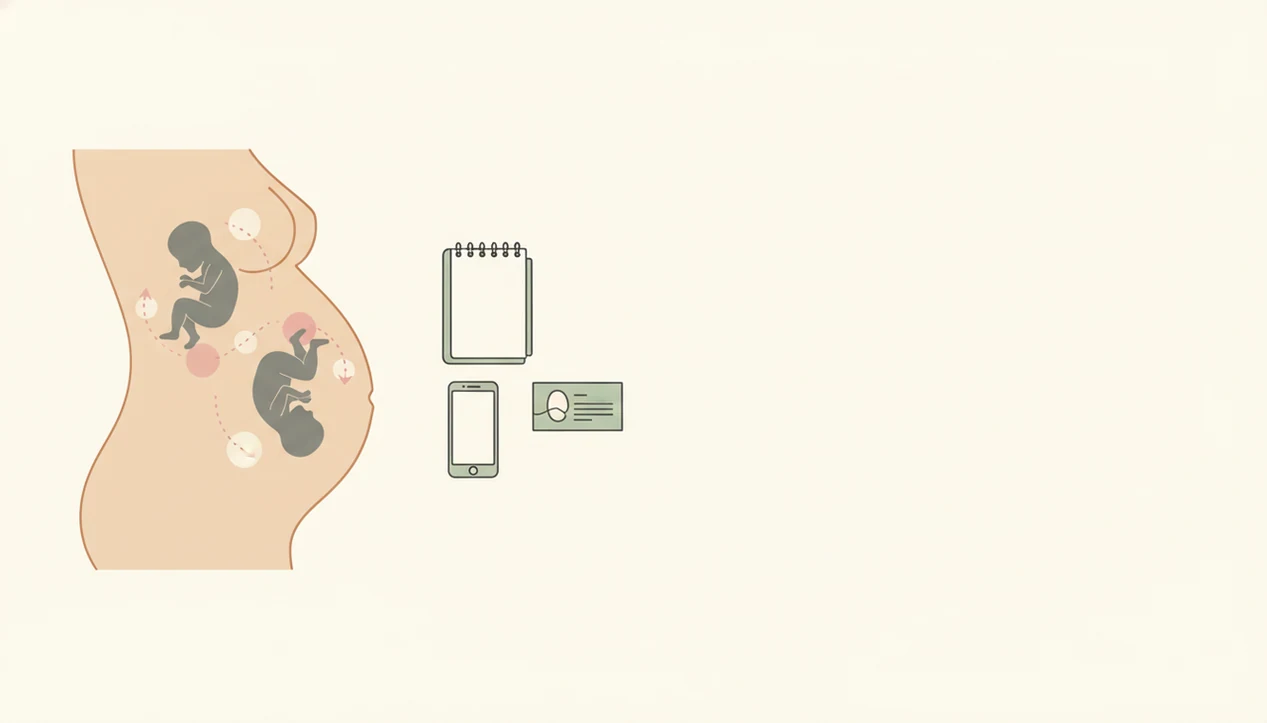
A kick counter for twins can help you keep more consistent notes about fetal movement, but it cannot always prove which twin moved. In twin pregnancies, the safest use is to track each baby’s usual pattern as best you can and follow individualized instructions from your prenatal provider.
This page is educational and does not diagnose fetal wellbeing; use any kick-counting app only as a note-taking aid alongside your prenatal provider’s plan.
- Twin kick counting is usually about noticing pattern changes, not perfectly identifying every movement by baby.
- A twins kick count app can improve routine and documentation, but it cannot diagnose fetal distress.
- Provider guidance matters more with twins because fetal position, placentas, growth, and pregnancy risk factors vary.
Kick Counter For Twins At A Glance
A kick counter for twins is a tracking aid for movements, rolls, jabs, flutters, stretches, and pattern notes in a twin pregnancy. Its job is to support observation, not prove with certainty which baby moved every time.
With twins, the practical goal is usually learning what feels typical for each baby over time. One baby may be easier to feel on the right side. The other may show up as a softer swish after you change position. That difference can matter when you are building a daily kick count routine.
A twins kick count app can make the notes cleaner than a crumpled notebook page at the bottom of a purse. But reduced, absent, or meaningfully changed movement should prompt provider contact, not app interpretation.
Write down what changed.
Five Facts About Twin Kick Count App Limits
- Twin movement tracking is harder because two babies can move close together, overlap sensations, or shift positions during the third trimester.
- Pattern change matters more than perfect counting precision because a usual movement pattern is often more useful than a single isolated number.
- Third-trimester reduced or changed movement warrants prompt clinical advice, especially when the change feels different from your established baseline.
- Provider-specific thresholds are especially important in twin pregnancies because chorionicity, placental location, fetal growth, and other risks vary.
- Apps help with recordkeeping, reminders, and session history, but they do not diagnose fetal distress or confirm that both babies are well.
Clinicians typically recommend calling your care team for reduced or unusual fetal movement rather than waiting for an app, chart, or home routine to explain it. For general clinical context, ACOG describes fetal movement counting as one way to monitor fetal wellbeing and advises contacting a clinician when movement is decreased: source. The folded kick count handout in a hospital bag still matters because it usually contains your own clinic’s escalation plan.
Twin Pregnancy Fetal Movement Tracker Guidance
Twin pregnancies are harder to track because fetal position, chorionicity, placental location, and growth patterns can change how movement is felt. Two babies may also have different baselines and different active times.
One twin might be active after dinner. The other may have a later pattern, closer to bedtime. If one placenta is anterior, some jabs may feel muted or spread out. Our guide to kick counting with anterior placenta explains that sensation issue in more detail.
Ask your clinician three plain questions: how often should I count, what threshold should I use, and when should I call? Those answers may differ from another twin parent’s instructions.
No single rule fits every twin pregnancy.
For twin pregnancies, provider-directed movement tracking is often safer than generic app thresholds because placentas, fetal positions, and risk factors differ.
How A Kick Counter For Twins Works
A kick counter for twins works by turning felt fetal movement into a dated session history: the parent feels movement, logs the time and count, adds notes, and reviews patterns across days.
The data flow is simple. You notice a roll, jab, flutter, or stretch. You start a movement session. The app stores the count, time of day, duration, and any notes about suspected Twin A or Twin B. Later, you compare today’s entry with prior sessions.
These are subjective observations, not diagnostic measurements. In behavioral tracking terms, the routine helps build a baseline, which means a repeated pattern you can recognize more easily over time. The lay version is this: same time, same place, better comparison.
Attribution can still be uncertain. When twins are close together, one rib tickle during a deep breath may not clearly belong to either baby. A good fetal kick counter and pregnancy movement tracking app for third-trimester monitoring deliver organized pattern notes, not medical reassurance or a diagnosis.
How To Use A Fetal Movement Tracker For Twins
Use a fetal movement tracker for twins as a structured note-taking routine, with your provider’s instructions as the rulebook. If you need a broader walk-through, the basics are covered in how to count kicks with twins.
- Ask your provider for the preferred counting routine, movement threshold, and escalation plan for your twin pregnancy.
- Choose a consistent time and position, such as sitting on the couch after dinner with a phone timer open.
- Log each movement session with time of day, duration, count, and what you were doing before you started.
- Label the suspected baby when you can, but mark “unsure” when the movement could belong to either twin.
- Review several sessions for your usual movement pattern, including quieter periods and more active windows.
- Call your provider promptly for reduced, absent, or meaningfully changed movement, even if an earlier session looked normal.
The most common medically supported way to use kick counting is consistent observation combined with prompt clinical advice when movement changes.
When To Call Your Provider About Twin Movement
Call your provider promptly if twin movement is reduced, absent, or meaningfully different from the pattern you have been tracking. A reassuring count earlier in the day should not make you wait if something now feels wrong.
In a twin pregnancy, the right next step is the one your clinic has already given you, because your plan may depend on placentas, fetal positions, growth, chorionicity, and other risk factors. Avoid using a generic number from an app, a friend, or an online chart to overrule that individualized advice.
- Notice the change clearly, including whether it feels like one baby, both babies, or you are unsure.
- Check your clinic’s twin-specific instructions for who to call, which number to use, and whether to go directly to triage.
- Call now for reduced, absent, or unusual movement instead of repeating sessions until the log looks better.
- Share your recent movement notes, timing, positions, and any symptoms your provider asks about.
- Follow the care team’s direction, which may include monitoring, ultrasound, or other provider-directed testing.
Use the tracker as a record for the call, not as permission to delay it.
Best App Features In A Twins Kick Count App
Useful twins kick count app features are the ones that make notes clearer without pretending to identify fetal distress. Look for practical structure, not extra pregnancy clutter.
- Separate baby profiles or labels: Twin A, Twin B, and “unsure” labels help preserve uncertainty instead of forcing a false answer.
- Timed movement sessions: A clear start and stop time keeps one session from blending into the rest of the evening.
- Notes field: Position, side, recent activity, and unusual sensations can explain why a session felt different.
- History view: A simple log helps compare today with earlier movement sessions.
- Provider-ready summary: Exportable notes are easier to share than scattered screenshots or paper scraps.
A focused Fetal Kick Tracker can help count kicks and track movement patterns, but it should still be used alongside your provider’s instructions, especially if you are also following a kick counter for high-risk pregnancy plan.
Common Twin Kick Counting Patterns And What They Mean
Twin movement can vary with active periods, quiet periods, fetal sleep cycles, your activity level, and time of day. A quieter session does not automatically mean something is wrong, but a meaningful change deserves attention.
One baby may feel more obvious because of position. Another may be cushioned by placenta location or tucked where movements feel like pressure instead of jabs. Some parents notice a familiar flutter after cold juice, then a different rolling pattern later at night.
Patterns matter most when your provider has approved a routine for comparing them. Several sessions can show whether one twin usually moves earlier, later, stronger, or softer.
Still, baseline tracking has a limit. A decrease, absence, or unusual change should be escalated to your care team rather than watched for days.
The pocket check is real.
Common Myths About Kick Counter For Twins Accuracy
A kick counter cannot reliably identify which twin moved every time. It can help you label what you think happened, but overlapping positions and shared space make certainty difficult.
Another myth is that fewer movements always means something is wrong. Fetal sleep cycles, your own activity, and placenta location can affect what you feel. The opposite myth is also risky: assuming every quiet spell is normal can delay a needed call.
An app does not replace clinician guidance. Twin pregnancies often need individualized instructions because growth, placentas, chorionicity, and monitoring plans differ.
Kick counting alone should not be described as preventing stillbirth. Outcomes research is mixed, and movement tracking is only one monitoring tool. For some pregnancies, extra surveillance may be tied to conditions such as growth concerns; related logging is discussed in kick counting after growth restriction.
Use the app as a record. Use your care team for decisions.
Evidence Behind Fetal Movement Counting In Pregnancy
The evidence for structured fetal movement counting is nuanced. A large 2021 randomized trial of 4,436 pregnant participants found that structured fetal-movement counting did not significantly reduce the composite adverse perinatal outcome compared with usual care source.
The trial included 2,211 participants in the fetal-movement-counting group and 2,225 in the usual-care group. The composite adverse perinatal outcome occurred in 3.1% of the counting group versus 3.2% in the usual-care group.
There was an important adherence detail. In the per-protocol analysis, which excluded women with poor adherence, the outcome was 2.4% versus 4.6%. That finding suggests consistency may matter, but it does not prove that counting works the same way for every pregnancy.
This evidence is not twin-specific enough to override clinician instructions. Twin pregnancies bring extra variables, so your provider’s plan should lead any fetal movement tracker twins routine.
Limitations
A kick counter can organize twin movement notes, but it has important limits.
- Twin-by-twin movement attribution is imperfect, especially when babies are close together or change position.
- Normal counts do not rule out all complications.
- Apps cannot diagnose fetal distress, placental problems, or whether both babies are well.
- Evidence for outcome improvement from kick counting is mixed and should not be oversold.
- App quality depends on regular use, accurate noticing, and honest notes such as “unsure which baby.”
- Twin pregnancies need individualized clinical advice for timing, thresholds, and escalation.
- A clean log may help a conversation, but it should not delay a call for reduced, absent, or meaningfully changed movement.
A focused Fetal Kick Tracker can make the history easier to show at an appointment. A phone screen beside blood pressure notes is useful only if clinical concerns still go to the clinician.
FAQ
Can you count kicks with twins?
Yes, kick counting can be used in a twin pregnancy, but the method should follow your provider’s instructions. The goal is usually pattern awareness, not perfect separation of every movement.
How can I tell which twin is moving?
You may be able to guess based on location, scan information, and repeated patterns. Exact identification can be difficult because positions and sensations overlap.
Do twins move less than single babies?
Twins do not have one universal movement pattern compared with single babies. Any change from your usual baseline should be discussed with your provider.
When should I call my provider about twin movement?
Call promptly for reduced, absent, or meaningfully changed movement. Do not wait for an app or another counting session to rule out concern.
Are kick counts different for twins?
They can be different because twins may have separate baselines, positions, and risks. Your provider should set the counting routine and call threshold.
Can an app track both twins?
An app can help label and organize notes for both twins. It cannot verify which baby moved or diagnose fetal distress.
How often should I count kicks with twins?
The frequency should come from your prenatal provider, especially in a twin pregnancy. Some people need more individualized monitoring than standard guidance suggests.
Do anterior placentas affect kick counts?
Yes, an anterior placenta can change how movement is felt. Your clinician can explain how placenta location applies to your tracking routine.
Can kick counting prevent stillbirth?
Kick counting is a monitoring tool, not a guarantee. Evidence on hard outcome improvement is mixed, so changed movement still needs clinical advice.