How To Count Kicks With Twins And What To Ask Your Provider
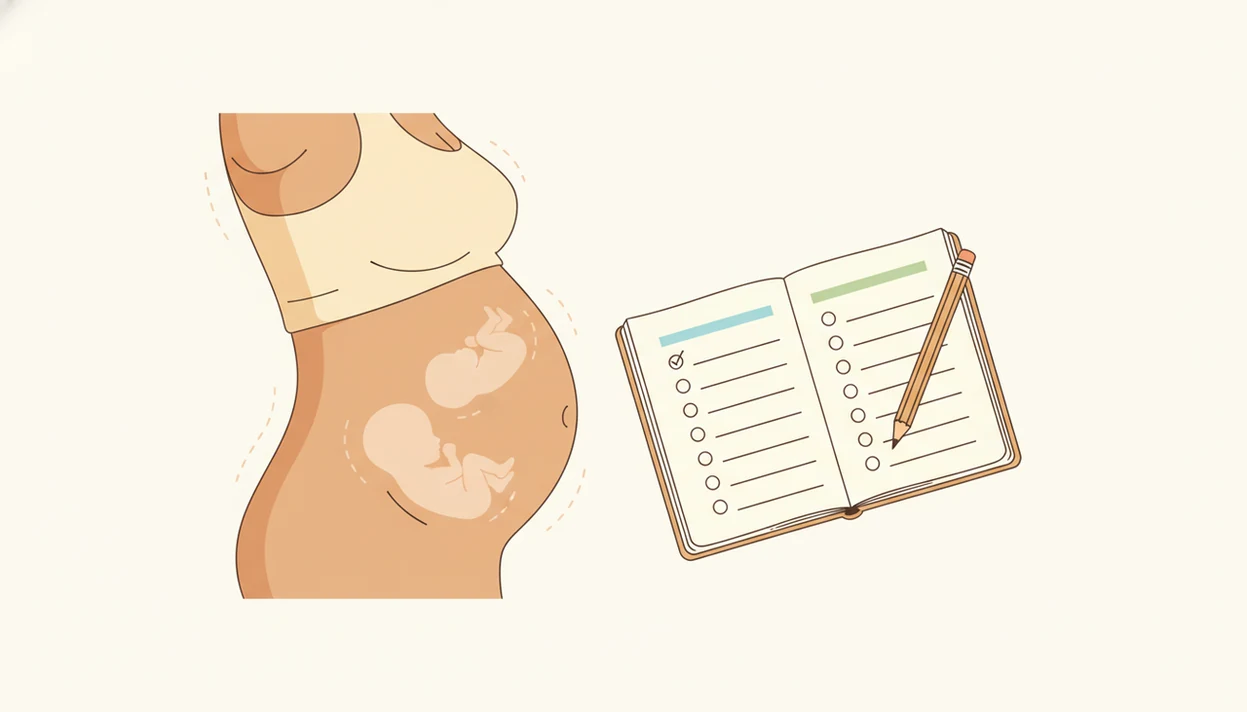
How to count kicks with twins usually means tracking each baby separately, at a consistent active time of day, and calling your provider if either twin’s usual movement pattern slows down or changes. Your provider may adapt the exact timing, threshold, or follow-up plan based on your twin pregnancy, placenta positions, gestational age, and risk factors.
Definition: Twins kick counting is a repeatable third-trimester routine for noticing each twin’s usual movement pattern and responding quickly when Baby A or Baby B moves less than normal.
TL;DR
- Ask your provider when to start, which twin is Baby A or Baby B, and whether they want 10 movements within 1–2 hours or a different plan.
- Count one twin’s full session first, then the other twin’s session, if you can tell their movement zones apart.
- Do not dismiss a clear slowdown as “normal because twins are crowded”; call your provider or go in for assessment if either twin’s pattern changes.
At-a-glance twins kick counting plan
Start with your provider’s instructions, because twin pregnancies are not managed with one universal rule. Most routines use a consistent active time, a comfortable position, and separate logs for Baby A and Baby B.
Movements can include kicks, rolls, jabs, stretches, and swishes. Hiccups are usually not counted because they are rhythmic reflexes, not the same kind of voluntary movement. A common protocol is to count until 10 movements are felt within up to 1–2 hours, but the more useful signal is each twin’s usual baseline.
Same chair. Same time. Less guessing.
If either twin has a sudden decrease, takes much longer than usual, or feels meaningfully different, call promptly. Keep a written or app log that shows the date, start time, side felt, and how long each session took. For more twin-specific setup, a kick counter for twins can help organize separate sessions.
Five facts about counting fetal movement twins parents should know
- Daily counting may be discussed around 26 weeks in many twin pregnancies, but your provider decides when it fits your care plan. For example, Tommy’s notes that fetal movements are usually felt by 16–24 weeks and advises contacting maternity services if movements slow, stop, or change: source. - One twin may be easier to feel because of fetal position, placenta placement, or where your attention is during the movement session. - Baby A and Baby B should be interpreted by their own usual patterns, not compared as if they should move equally. - Many babies reach 10 movements in under 30 minutes, but up to 2 hours is commonly used in recognized pregnancy guidance. - Decreased movement should trigger contact with the healthcare team rather than home reassurance or another long wait.
The notebook problem is real: one crumpled page at the bottom of a purse rarely helps during triage. A dated log is easier to explain when someone asks, “What changed, and when?”
How twins kick counting works in the third trimester
Twins kick counting works by building a perception-based baseline for each baby, then watching for a meaningful deviation from that baseline. It is a screening routine, not a diagnostic test.
Movement perception changes with fetal position, placenta location, maternal activity, and gestational age. An anterior placenta can muffle movement. A baby tucked deeper toward the back may feel quieter than a twin whose feet press near the front. Clinicians typically recommend reporting decreased fetal movement because it can lead to evaluation, such as non-stress testing or a biophysical profile, when appropriate.
ACOG describes a commonly used approach of counting until 10 movements are perceived, often within 1–2 hours, and reporting if that threshold is not met source. For twins, the practical goal is not proving both babies are identical. It is noticing when Baby A or Baby B no longer acts like themselves.
Questions to ask before counting kicks with twins
“How should I count kicks with my twins?” is the right question to ask your provider before you build the routine. Bring it up directly, even if you already have a folded kick count handout tucked into the side pocket of your hospital bag.
Ask when to start daily counts for this specific pregnancy. Many twin pregnancies discuss movement awareness earlier than singleton pregnancies, but your gestational age and risk factors matter. Ask how your office labels Baby A and Baby B, whether their positions seem stable, and what movement zones you should use at home.
Also ask what threshold should trigger a call. Is it fewer than 10 movements in 2 hours, a longer-than-usual session, or any clear change? Confirm whether they want both twins counted daily, more than once daily, or only when concerned. Last, write down the after-hours number and whether they want you to call first or go directly to labor and delivery.
How to use a twins kick counting routine
For twins, separate sessions usually create cleaner data than counting both babies together because each twin gets their own time, notes, and pattern history. The most common medically supported way to count fetal movement is a timed movement session combined with prompt contact if movement is reduced.
Before you start, confirm with your provider whether Baby A and Baby B have reliable movement zones and whether your pregnancy needs a different threshold than the common 10-movement routine. If you cannot tell which twin moved, log that uncertainty instead of forcing a guess.
Set a consistent active window
- Choose a daily time when both twins are usually active, such as after dinner or before bed.
- Sit or lie in a position that makes movement easier to feel.
- Start with the same setup each day, so the routine is easier to compare.
Count Baby A first
- Focus on Baby A’s known area and count rolls, jabs, swishes, and stretches until the target or provider time limit is reached.
Reset and count Baby B
- Pause the session, reset the timer, and then count Baby B separately.
Log each twin separately
- Record the time, movement strength, location felt, and any notes for each twin.
Call for a pattern change
- Call your care team if either twin is slower, quieter, or different from their usual pattern.
Baby A vs Baby B movement tracking table
A side-by-side log helps separate what happened for Baby A from what happened for Baby B. One twin may have a quieter or harder-to-feel baseline, so equal movement is not the goal.
| Field to track | Baby A | Baby B |
|---|---|---|
| Location felt | Low left, low right, upper belly, or provider-noted zone | Low left, low right, upper belly, or provider-noted zone |
| Typical active time | Example: 9 p.m. after brushing teeth | Example: early morning or after dinner |
| Time to 10 movements | Record minutes, not just “done” | Record minutes, not just “done” |
| Movement strength | Light flutters, firm jabs, rolls, stretches | Light flutters, firm jabs, rolls, stretches |
| Notes | Position change, meal timing, concern | Position change, meal timing, concern |
Separate app profiles or side-by-side timelines can reduce mix-ups, especially when both babies move during the same session. If paper charts are easier for appointments, kick count charts and logs can still work well.
Common myths about how to count kicks with twins
Myth 1: There is one correct kick count number for every twin pregnancy. Your provider may use 10 movements in up to 1–2 hours, but the key is each twin’s usual pattern.
Myth 2: Both twins must move the same amount in every session. Baby A and Baby B can have different baselines because of position, placenta location, and activity cycles.
Myth 3: Reduced movement is normal because twins run out of room. Late pregnancy movement may feel different, but a clear slowdown still needs a call.
Myth 4: You cannot learn which twin is moving. Many parents can learn likely zones over time, especially after asking where each baby is positioned.
Myth 5: A normal count means nothing can be wrong. Kick counting is useful, but it cannot rule out every concern.
A good fetal kick counter and pregnancy movement tracking app for third-trimester monitoring delivers organized pattern notes, not a medical interpretation of fetal wellbeing.
When twins kick counting should trigger a call
“When should I call about twin movement?” Call if either twin has a sudden decrease, a major slowdown, or movements that feel meaningfully different from that twin’s usual pattern. Do not wait for the next scheduled session if you are worried.
Call if your provider’s movement threshold is not met. Also call if the pattern changes after you change position, drink water, or sit quietly. Those steps can help you focus, but they should not become a long home test when something feels wrong.
Most evaluations for decreased fetal movement are reassuring. In a large Norwegian cohort of 2,794 women presenting with decreased fetal movements, 96% had normal pregnancy outcomes, while 4% had adverse outcomes source. That is why decreased movement is taken seriously without assuming the worst. For higher-risk situations, your provider may give a tighter plan, similar to guidance used in kick counter for high-risk pregnancy monitoring.
How Baby Kicks App supports twins kick counting
Baby Kicks App can help organize twin kick-count notes without turning the log into medical advice. For twins, the safest use is separate date-stamped records for Baby A and Baby B, including session duration, movement strength, location felt, and any notes your provider asked you to track.
A Fetal Kick Tracker is most helpful when it makes the pattern easy to share during a call or visit. It should not interpret fetal wellbeing, replace triage advice, or reassure you to wait when either twin’s movement pattern has clearly changed.
The date-stamped movement history screen matters most during a real call. If your provider asks what changed, you can read the time, duration, and notes instead of reconstructing the week from memory. For parents who need separate digital records, an app that tracks twins kicks separately may reduce confusion.
Limitations
Kick counting with twins has real value, but it has safety limits. Use it as a screening habit and conversation tool, not as proof that everything is fine.
- Kick counting is based on perceived movement, not a diagnostic test.
- Normal counts do not guarantee that there are no problems.
- High-quality research validating exact numeric thresholds specifically for uncomplicated twin pregnancies is limited.
- Placenta location, fetal position, maternal body position, and attention can change what you feel.
- An anterior placenta may make movement harder to detect; more detail is covered in kick counting with anterior placenta.
- App logs can show patterns, but they cannot interpret fetal wellbeing.
- Provider instructions override general internet guidance, including this guide.
- Reduced movement should be evaluated even if a previous visit was reassuring.
Blunt but important: one reassuring afternoon does not cancel a new concern tonight. Call your care team if either twin’s pattern changes.
FAQ
When do twin kick counts start?
Many twin pregnancies discuss daily movement counting around 26 weeks, but the exact start date should come from your provider. Some pregnancies need earlier or more structured monitoring.
Can I count both twins together?
Separate sessions often create cleaner data if you can distinguish Baby A from Baby B. Counting both together can make it harder to know which twin reached the target.
How many kicks should twins have?
A common protocol is 10 movements within up to 1–2 hours for each baby. Your provider may set a different threshold based on your pregnancy.
Do hiccups count as kicks?
Hiccups are usually not counted during kick count sessions. Count rolls, jabs, swishes, stretches, and kicks instead.
What if one twin moves less?
One twin may have a quieter baseline or be harder to feel. A decrease from that twin’s normal pattern should prompt a call.
Can placenta position hide movement?
Yes, an anterior placenta or certain fetal positions can make movement harder to feel. Your provider can explain how placenta location affects your movement tracking.
Should twins move every hour?
Twins do not have to move every hour because babies have sleep-wake cycles. Focus on daily patterns and your provider’s instructions.
Is reduced movement normal late?
Reduced movement is not automatically normal just because twins have less space. A clear decrease or change should be discussed with your care team promptly.
When should I call triage?
Call triage immediately for a sudden decrease, a missed provider threshold, or a movement pattern that feels wrong. Do not wait for the next routine count.