Kick Counting With Gestational Diabetes Care Plans
Kick counting with gestational diabetes is usually an at-home way to notice changes in your baby’s movement pattern between prenatal visits, not a replacement for your provider’s monitoring plan. Many care teams recommend daily third-trimester movement tracking and want you to call right away for decreased movement or a pattern that feels unusual for your baby.
Kick counting with gestational diabetes means tracking your baby’s kicks, rolls, jabs, and other movements in the third trimester while following an individualized high-risk pregnancy monitoring plan from your prenatal provider.
- Gestational diabetes often makes pregnancy higher risk, so daily fetal movement awareness may be part of your third-trimester care plan.
- Many clinicians use the “10 movements within 2 hours” kick count benchmark, but your provider may give you a different threshold.
- Call your provider or labor and delivery triage promptly if movement is noticeably reduced, different from normal, or does not meet your care team’s instructions.
Kick counting with gestational diabetes: what it means
Kick counting with gestational diabetes means watching your baby’s usual movement pattern while also following a higher-risk pregnancy care plan. Counts usually include kicks, rolls, flutters, jabs, swishes, stretches, and other movements your provider says to count.
Gestational diabetes is a pregnancy risk factor, so many care teams add daily movement awareness in the third trimester. That does not mean kick counts diagnose a problem or treat diabetes. They simply give you a same-time, same-place record between visits.
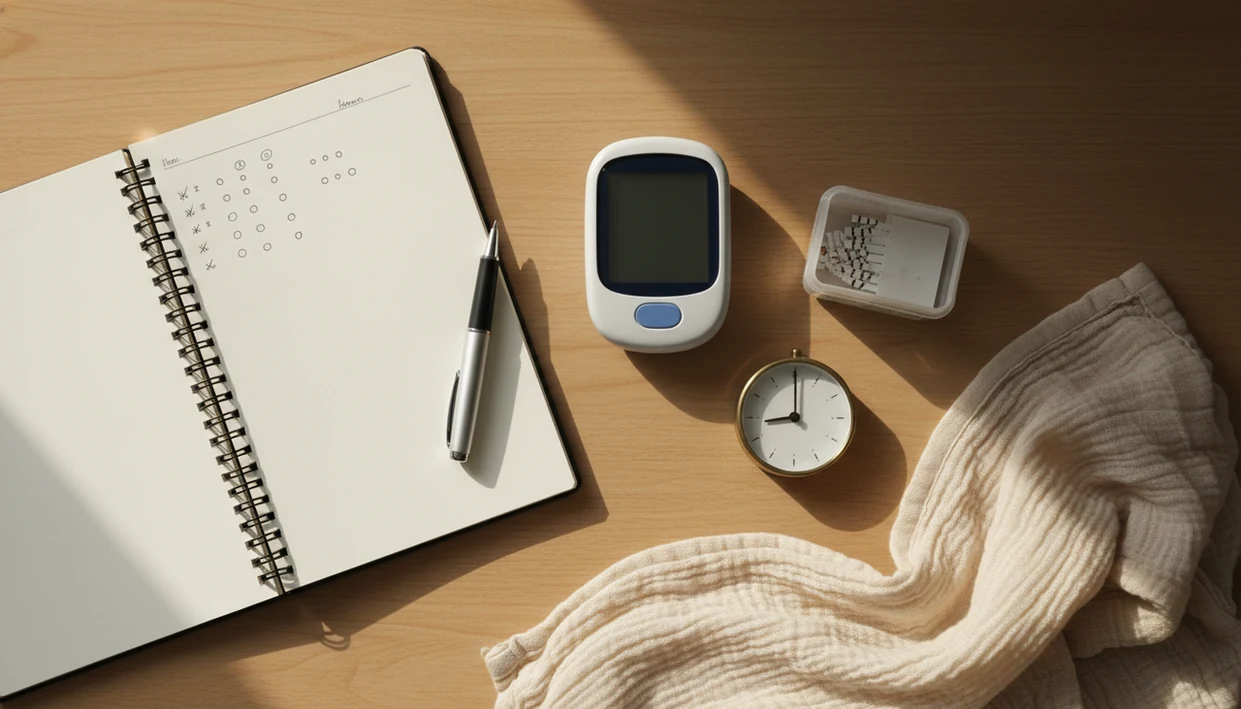
A simple log matters when memory gets fuzzy. A crumpled notebook page at the bottom of a purse is easy to lose before an appointment.
A structured movement log can help you bring clearer dates, times, and pattern notes to prenatal appointments.
Gestational diabetes fetal movement monitoring statistics
Gestational diabetes fetal movement monitoring is emphasized because gestational diabetes is common enough to affect routine prenatal care, and movement changes can be a reason for timely evaluation. Most people with gestational diabetes have healthy babies, but monitoring creates a clearer path for calling sooner.
- CDC surveillance data report gestational diabetes prevalence in the U.S. at roughly 6–9%, varying by year and population: https://www.cdc.gov/pcd/issues/2024/23_0295.htm
- A U.S. multicenter cohort reported 6.0% positive screening using Carpenter–Coustan criteria and 5.1% using National Diabetes Data Group criteria: https://pubmed.ncbi.nlm.nih.gov/24908733/
- A U.S. cohort study of 129,166 pregnancies found gestational diabetes was associated with higher adjusted odds of stillbirth; use this as risk context, not a prediction for an individual pregnancy: https://pubmed.ncbi.nlm.nih.gov/23069874/
- These numbers support careful follow-up, not panic.
- Movement tracking is most useful when the log leads to action, such as calling triage when the pattern changes.
High-risk diabetes kick count monitoring methods
How kick counting works: it tracks your baby’s individual baseline, not whether your baby moves like someone else’s baby. The mechanism is pattern recognition, which means noticing repeated timing, frequency, and strength over days.
Common methods include timing how long it takes to feel 10 movements or counting movements during a fixed window. ACOG commonly references that most fetuses make 10 movements within 2 hours during formal kick counts.
Clinicians typically recommend using kick counts as one part of high-risk monitoring, alongside the provider’s instructions. If movement changes, your care team may suggest a non-stress test, ultrasound, or biophysical profile. The most common medically supported way to use kick counts is daily pattern tracking combined with prompt reporting of decreased movement.
A folded kick count handout in the side pocket of a hospital bag can be more useful than a polished-looking chart you never use.
Daily kick count timing in gestational diabetes care plans
When should daily kick counts start with gestational diabetes? Many providers recommend daily counts in the third trimester, often around 26–32 weeks and beyond, but your exact start week should come from your care team.
How to use kick counting in a gestational diabetes care plan:
- Ask your provider when to start, how often to count, and what number should trigger a call.
- Choose a time when your baby is usually active, such as after dinner or during a quiet evening stretch.
- Sit or lie comfortably, then start a timer and count each clear movement.
- Write down the date, time, duration, count, and anything that felt different.
- Call your care team if the count is low or the pattern feels wrong.
Plans vary by glucose control, medications, fetal growth, blood pressure, and other risks. For broader high-risk routines, a kick counter for high-risk pregnancy guide can help frame the questions to ask.
Kick count numbers and gestational diabetes fetal movement patterns
A fetal movement usually means a kick, roll, jab, flutter, swish, or stretch unless your provider gives different instructions. The number matters, but the pattern matters too.
| Kick count item | Common guidance | What to remember |
|---|---|---|
| Movement definition | Kicks, rolls, jabs, flutters, stretches | Hiccups may be handled differently by some providers |
| Common benchmark | 10 movements within up to 2 hours | Often used in formal kick counts |
| Other thresholds | Fewer than 6 movements in 2 hours may raise concern in some systems | Follow your local instructions |
| Pattern change | Sudden slowdown or weaker pattern | Call even if a number is eventually reached |
For gestational diabetes, the useful question is not “Did I pass?” It is “Does this match my baby’s usual pattern?” For many people, kick count charts and logs are easier than memory because they preserve the small details.
Decreased fetal movement calls with gestational diabetes
Call your prenatal provider, labor and delivery unit, or triage right away if movement is decreased or the pattern feels wrong. Do not wait until the next day when fetal movement is reduced.
- Call if you feel fewer movements than your provider told you to expect.
- Call if there is no response during a time your baby is usually active.
- Call for sudden quietness, even if you are busy or unsure.
- Call for a major change from baseline, such as weaker rolls or fewer jabs.
- Calling does not mean something is definitely wrong; it means the baby may need evaluation.
The bathroom floor during a quiet scare is not the place to debate whether you are “overreacting.” Write down what changed, then call.
A good fetal kick counter and pregnancy movement tracking app for third-trimester monitoring can organize dates, times, and counts, not replace urgent clinical advice.
Baby kick tracker app notes for gestational diabetes appointments
An app can make daily logging more consistent than memory alone, especially when prenatal visits, glucose checks, meals, and medication timing are already competing for attention. Tools like Baby Kicks App can support a structured routine, but they are not medical devices or substitutes for care.
Useful appointment notes include:
- Date and time: Record when each movement session started.
- Duration: Note how long it took to reach the target count.
- Movement count: Include kicks, rolls, jabs, flutters, and stretches as instructed.
- Pattern notes: Add unusual quietness, stronger activity, or a change after meals.
- Call history: Record when you called the provider and what they advised.
Structured tracking can lower guesswork, but it should not become a reason to keep counting when something feels wrong. Stop counting and call.
Non-stress tests, growth scans, and kick counts with gestational diabetes
Kick counting does not replace non-stress tests, biophysical profiles, growth ultrasounds, glucose monitoring, or prenatal visits. It adds between-appointment information that may help you call sooner.
- Providers may increase monitoring based on medication use, glucose control, fetal growth, blood pressure, or other risk factors.
- A non-stress test checks fetal heart rate patterns; a kick count records perceived movement at home.
- Growth scans look at size and fluid, not your whole daily movement pattern.
- A Norwegian quality-improvement study of more than 68,000 births reported late stillbirth reduction from 3.0 to 2.0 per 1,000 after standardized fetal-movement information and response systems were introduced: https://pubmed.ncbi.nlm.nih.gov/19624829/
- The benefit depends on education, access to care, and clear instructions after a concern.
If you also have another finding, such as growth restriction, kick counting after growth restriction may involve a more specific plan.
Medical Review and Source Basis
This page is educational only and is not individualized medical advice. It is meant to help you prepare better questions and clearer notes for your own prenatal team.
The guidance is based on common source types used for pregnancy education, including CDC public health materials, ACOG-style clinical guidance, and peer-reviewed studies on gestational diabetes, fetal movement awareness, and stillbirth risk. Because kick counting thresholds are general benchmarks, your provider’s instructions override anything here, especially if you have medication-treated gestational diabetes, growth concerns, hypertension, twins, reduced fluid, or a prior loss.
For medical accuracy, this page should be reviewed at least annually and updated sooner when major obstetric guidance changes. If you use an app or paper log, treat it as a record-keeping tool, not a gatekeeper for care.
- Follow the movement plan your provider gave you.
- Use general benchmarks only when your care team has not given a different threshold.
- Call promptly for decreased, absent, or clearly unusual movement.
- Bypass app logging when movement feels urgently reduced and contact labor and delivery, triage, or your prenatal provider right away.
Limitations
Kick counting is useful, but it has firm limits in gestational diabetes care. It should never be used to talk yourself out of calling when movement feels reduced.
- Kick counting cannot diagnose or treat placental insufficiency, preeclampsia, fetal distress, or gestational diabetes complications.
- There is no single universally agreed kick counting method or cutoff.
- An anterior placenta, higher BMI, fetal position, fetal sleep cycles, and distractions can make movement harder to feel.
- Normal movement patterns vary between babies, so comparison with other pregnancies can mislead.
- A reassuring kick count does not cancel provider instructions for NSTs, ultrasounds, glucose checks, or urgent evaluation.
- Evidence on routine kick counting alone is mixed; benefits depend on education, response plans, and follow-up access.
- Twins and other complex pregnancies need individualized advice; a kick counter for twins may require separate tracking instructions.
Small records help. They do not clear risk.
FAQ
When should I start kick counts with gestational diabetes?
Many providers recommend starting daily kick counts in the third trimester, often around 26–32 weeks. Your care team should give the exact start week, frequency, and calling threshold.
How many baby movements are normal in 2 hours?
Many clinicians use 10 movements within 2 hours as a common benchmark. Your baby’s usual movement pattern and your provider’s instructions matter more than a universal number.
Does gestational diabetes reduce fetal movement?
Gestational diabetes does not automatically mean your baby will move less. Any decrease or clear pattern change should be reported promptly.
When should I call triage for decreased fetal movement?
Call triage, labor and delivery, or your prenatal provider promptly for decreased movement, no movement during a usual active period, or any pattern that feels concerning. Do not wait until the next day.
Do kick counts replace non-stress tests?
No. Kick counts do not replace non-stress tests, ultrasounds, biophysical profiles, glucose checks, or provider visits.
Can I use a Fetal Kick Tracker for gestational diabetes?
Yes, a Fetal Kick Tracker can help you log movements consistently when used according to your provider’s plan. It should organize sessions, not replace medical care or delay a call for decreased movement.
Do babies slow down near birth?
Babies may feel different as space changes, but movement should not almost stop near birth. Call your provider if movement is reduced or noticeably different.
What counts as fetal movement during kick counts?
Kicks, rolls, jabs, flutters, swishes, and stretches usually count as fetal movement. Follow your provider’s instructions if they define movements differently.