Home Doppler vs Kick Counting for Fetal Awareness
For everyday fetal awareness, home Doppler vs kick counting is not an equal safety tradeoff: kick counting tracks movement patterns, while a Doppler only attempts to detect heart tones. If movement slows, stops, or feels different, contact your healthcare provider rather than using a heartbeat sound for reassurance.
This guide is general education only and cannot diagnose fetal well-being; follow your clinician’s instructions and call promptly for reduced, stopped, or noticeably changed movement.
- Kick counting tracks movements such as kicks, rolls, swishes, and jabs; a home Doppler listens for fetal heart tones.
- A heartbeat on a home Doppler does not prove fetal well-being and should not be used to ignore reduced or changed movement.
- If movement slows, stops, or feels noticeably different, call your healthcare provider rather than trying to get reassurance from a Doppler.
Home doppler vs kick counting, side by side
Side-by-side captures of the compared products. Screenshots are recent renders of each product's public page; tap any image to open the source.
Home Doppler vs kick counting at a glance
Home Dopplers detect fetal heart tones, while kick counting tracks fetal movement patterns over time. The central safety concern is false reassurance: hearing a heartbeat can delay care when movement has changed.
| Question | Home Doppler | Kick counting |
|---|---|---|
| What it measures | Heartbeat-like sounds at one moment | Movements such as kicks, rolls, swishes, and jabs |
| Best use | Emotional connection, if used cautiously | Daily third-trimester tracking |
| Main risk | False reassurance or misread sounds | Over-focusing on one number without noticing pattern change |
| When to act | Do not use it to decide safety | Call if movement slows, stops, or changes abruptly |
| Provider role | Professional use is interpreted in context | Your log helps describe what changed |
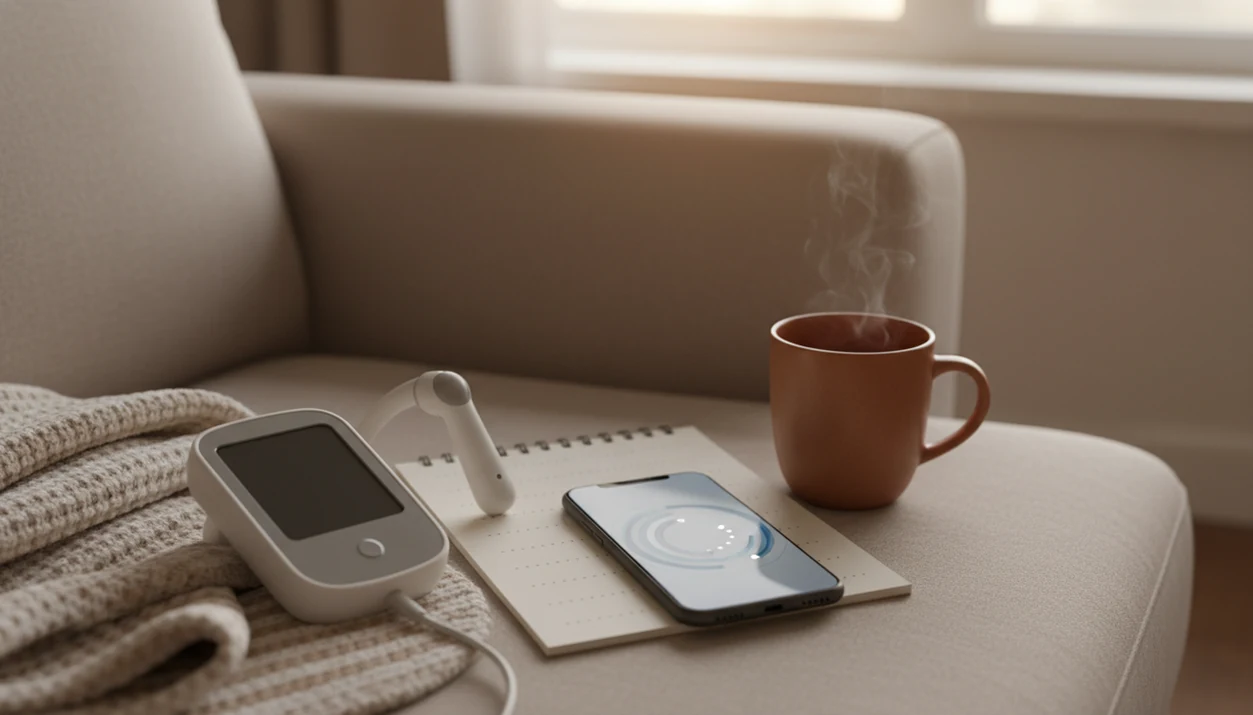
Reduced movement should trigger provider contact, not more Doppler checking. A phone timer open on the couch after dinner gives clearer pattern information than repeated searching for sound.
Five facts about fetal Doppler vs kick counts
These five facts summarize the safest way to compare fetal Doppler vs kick counts in the third trimester. Clinicians typically recommend acting on reduced or changed movement instead of relying on home reassurance.
- Kick counting is a recognized way to monitor fetal well-being because movement changes can be meaningful.
- Movement changes can signal fetal stress even if a heartbeat-like sound is heard at home.
- Count the Kicks recommends daily counting from 28 weeks, or 26 weeks for high-risk pregnancies or multiples source.
- Some guidance uses 10 movements in 1 hour, while some ACOG-linked patient guidance describes 10 movements within 2 hours source.
- The baby’s usual movement pattern matters more than treating one number as the only rule.
A folded kick count handout in a hospital bag is still useful. The daily pattern is the point.
How home Doppler safety in pregnancy actually works
Home Doppler safety in pregnancy depends less on hearing sound and more on how that sound is interpreted. A home fetal Doppler uses ultrasound to pick up fetal heart tones, but hearing tones is not the same as assessing fetal well-being.
The technical issue is signal interpretation. That means a lay user may hear maternal blood flow, placental sounds, or brief fetal tones and assume the result answers a bigger safety question. It does not. The FDA cautions against nonmedical fetal heartbeat monitors because ultrasound devices require trained use and interpretation source.
Kick counting asks a different question: “Is this baby moving in their usual pattern today?” That day-to-day pattern awareness is more useful for noticing change than a moment-in-time sound check. A soft swish after changing sides counts as information. So does a sudden quiet spell that feels unlike the baby’s normal routine.
How to use kick counting instead of home Doppler reassurance
Use kick counting as a repeatable daily routine, not as a test you have to pass. The most common medically supported way to notice fetal movement change is daily movement counting combined with prompt provider contact when the pattern changes.
- Set a consistent daily time when your baby is usually active, such as after dinner or before bed.
- Sit or lie on your side in a quiet place, with a timer or log ready.
- Count kicks, rolls, swishes, flutters, stretches, and jabs as movements.
- Time how long it takes to reach 10 movements if you use a 10-movement method.
- Review the usual pattern over days, including time of day and how long sessions take.
- Call your provider if movement slows, stops, or changes abruptly.
If you cannot feel 10 kicks in 2 hours, follow your provider’s instructions rather than waiting for a better session later.
Where home Doppler monitoring wins in pregnancy
A home Doppler may feel meaningful for some families because it can create a moment of emotional connection. A partner may hear heartbeat-like sounds and feel included, especially during a long stretch between appointments.
That value is real, but narrow. Professional Doppler use in prenatal care is different because clinicians know where to place the probe, how to distinguish sounds, and how to combine the finding with the full clinical picture. At home, the sound can be easy to overread.
Quiet counting together before sleep often gives a different kind of reassurance: shared attention to movement, not a promise of safety. A fetal kick counter and pregnancy movement tracking app for third-trimester monitoring can organize times and patterns, not diagnose fetal health or replace a clinician.
Where kick counting wins for third-trimester fetal awareness
Does kick counting give better everyday fetal awareness than a home Doppler? For routine third-trimester awareness, kick counting is often better than a home Doppler because it follows the baby’s usual movement pattern instead of one heartbeat moment.
Movement includes rolls, swishes, kicks, jabs, stretches, and other felt activity. The important warning sign is not only “fewer than 10.” It is reduced, stopped, or abruptly different movement compared with what is usual for your baby.
A movement log can support consistency by storing session times and patterns, especially when paper logs become a crumpled notebook page at the bottom of a purse. Apps can help you describe fetal movement patterns clearly, but they do not replace care when something feels off.
Home Doppler vs kick counting decision rule
The decision rule is simple: count for routine awareness, call for changed movement. If a Doppler finds a heartbeat but movement is reduced, stopped, or suddenly different, the next step is still provider contact.
| Situation | What to do |
|---|---|
| Movement feels normal for your baby | Keep tracking the usual pattern as directed |
| Movement is reduced or stopped | Call your provider promptly |
| Movement is suddenly different | Call, even if you recently heard a heartbeat |
| Doppler finds heart tones but movement changed | Do not use the sound as reassurance |
| You are unsure | Choose provider contact over home checking |
Choose kick counting for routine awareness
Use the same time and place when possible. A 9 p.m. alert after brushing teeth is plain, but it works.
Choose provider contact for changed movement
If you are deciding whether to wait, the safer question is covered in can I wait until tomorrow reduced kicks.
Common myths about home Doppler vs kick counting
Misconceptions about home Doppler vs kick counting can delay care. Pattern change is the key warning sign, even when a device seems reassuring.
- Myth: Hearing a heartbeat means everything is definitely okay. A heartbeat-like sound does not prove fetal well-being or explain reduced movement.
- Myth: Babies stop moving late in pregnancy because they run out of room. Movements may feel different, but a clear drop or stop should be discussed with a provider.
- Myth: Kick counting only matters if there are fewer than 10 movements. The baby’s normal pattern matters, including timing and session length.
- Myth: A home Doppler is safer than calling a clinician. Home checking can postpone the care conversation that matters.
- Myth: Apps can tell if the baby is okay. A Fetal Kick Tracker can organize logs, but it cannot clear a concern or replace provider contact when movement changes.
For urgent pattern questions, use a care-team rule such as when to call doctor reduced fetal movement.
Evidence and safety sources for home Dopplers and kick counting
Authoritative guidance points in the same direction: movement awareness can support timely care, while a home heartbeat sound should not be used as a safety check. These sources support noticing and reporting change, not diagnosing fetal well-being at home.
FDA cautions on nonmedical fetal heartbeat monitors focus on use without clinical need, training, or interpretation. In plain terms, finding sound is not the same as knowing what the sound means. NHS and ACOG-aligned guidance on reduced fetal movement also emphasizes contacting a maternity unit or clinician when movement is reduced, stopped, or feels different from the baby’s normal pattern.
Use the evidence as a simple action plan:
- Count movements routinely in the third trimester as your clinician recommends.
- Use Count the Kicks timing as a program guideline: daily counting from 28 weeks, or 26 weeks for high-risk pregnancies or multiples when advised.
- Notice pattern changes, not only whether one session reaches a number.
- Avoid using a home Doppler to overrule your concern.
- Call your provider for reduced, stopped, or noticeably changed movement.
That is the decision rule again: count routinely, call for change.
Limitations
Kick counting is useful, but it has limits. It is a screening habit, not a diagnosis, and it cannot identify the exact cause of reduced movement.
- Kick counting cannot prove that a baby is safe.
- Kick counting cannot diagnose why movement changed.
- Different providers may use different thresholds or timing windows.
- Home Dopplers can detect heart tones without confirming fetal well-being.
- A normal-feeling day does not guarantee safety.
- Movement tracking apps help consistency, but they do not replace medical assessment.
- Always follow individualized guidance from your clinician, especially for high-risk pregnancy, multiples, or prior concerns.
A phone screen shown at an appointment can help the conversation move faster. However, if the log shows a change, the log is not the treatment. The call is the next step.
FAQ
Is kick counting better than using a home Doppler?
Kick counting is better for routine movement awareness because it tracks the baby’s usual pattern over time. A home Doppler cannot rule out problems or replace provider advice.
Can a home Doppler replace kick counts?
No. A home Doppler should not replace movement tracking, your provider’s instructions, or a call about reduced or changed movement.
Can a home Doppler falsely reassure me?
Yes. Hearing a heartbeat-like sound can falsely reassure someone when movement is reduced, stopped, or different.
When should I start kick counting in pregnancy?
Many movement-counting programs start daily counts at 28 weeks. Some recommend 26 weeks for high-risk pregnancies or multiples, especially when a clinician advises it.
How many kicks should I feel during kick counts?
Some methods use 10 movements in 1 hour, and others use 10 movements within 2 hours. Your baby’s usual pattern is also important.
Do rolls and swishes count as kicks?
Yes. Rolls, swishes, jabs, flutters, stretches, and similar felt movements generally count during kick counting.
Should I call my provider for reduced fetal movement?
Yes. Contact your healthcare provider promptly if movement slows, stops, or changes from your baby’s usual pattern.
Is a home Doppler safe to use during pregnancy?
The concern is not only exposure. The larger safety issue is misinterpretation and delayed care after hearing a reassuring sound.
Do babies normally move less near birth?
Babies may move differently near birth, but they should not simply stop moving. Report reduced, stopped, or noticeably changed movement to your provider.