Cannot Feel 10 Kicks In 2 Hours? Know The Next Step
If you cannot feel 10 kicks in 2 hours, contact your healthcare provider, maternity triage, nurse advice line, or hospital for guidance, especially if this is unusual for your baby. A second quiet count can happen if that matches your provider’s instructions, but persistent low movement or a clear change from your baby’s normal pattern should not be managed by an app alone.
> This page is for general education only and is not a diagnosis or a substitute for maternity triage. If movement is reduced or unusual, use your local provider's instructions and call for clinical guidance.
- The common third-trimester benchmark is 10 movements within 2 hours, but your baby’s usual pattern matters more than one exact number.
- If you did not get ten movements and movement still feels reduced after a focused repeat count, call your provider or maternity unit now.
- Do not use an app, home doppler, snack, or reassurance from past normal counts as a reason to delay care when movement feels wrong.
Not enough kicks in two hours: immediate next step
If movement is still reduced after a focused count, call your provider, maternity triage, nurse advice line, or hospital now. One low count is not proof that something is wrong, but reduced fetal movement is important enough to discuss with a clinical team the same day.
If you cannot feel 10 kicks in 2 hours and that is different from your baby’s usual movement pattern, do not wait for tomorrow’s count. Write down when you started, what you felt, and what changed. That detail helps when you speak to triage.
The bathroom floor during a quiet scare is not the place to decide alone.
Apps are tracking tools, not medical assessment tools. They can organize a movement session, but they cannot check oxygen, placenta function, or fetal wellbeing. For a fuller safety path, our guide on when to call doctor reduced fetal movement explains when a call should happen.
At-a-glance guide when you did not get ten movements
Use this guide as a safety filter, not as a diagnosis. Strong intuition that something is wrong should trigger a call, even if the count is close to ten.
| What happened during counting | Safer next step |
|---|---|
| No movement at all | Contact maternity triage, your provider, nurse advice line, or hospital immediately. |
| Much less movement than your baby’s usual pattern | Call now, even if you felt a few rolls or jabs. |
| Fewer than 10 movements in 2 hours, first low count, no other concern | Follow your provider’s local instructions. Repeat only if that is the plan they gave you. |
| Normal pattern clearly returned | Keep logging, but call if movement drops again or feels different. |
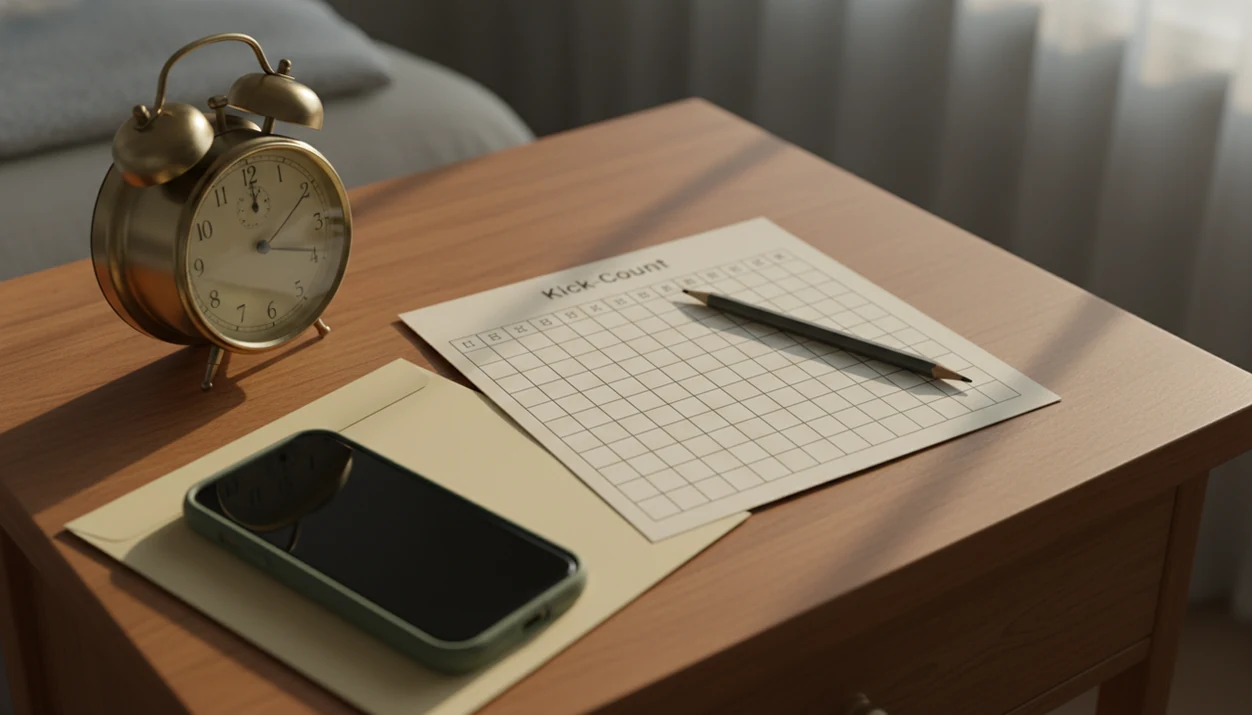
Clinicians typically recommend responding to reduced movement based on both the count and the baby’s usual pattern. A snack wrapper beside the phone may mark one quiet session, but the bigger question is whether today feels unlike your baby.
How the 10 kicks in 2 hours benchmark works
The 10-kicks-in-2-hours benchmark is a third-trimester screening habit that times how long it takes to feel 10 fetal movements, not a diagnosis of fetal health. A movement can be a kick, roll, flutter, swish, stretch, jab, or other noticeable shift.
Cleveland Clinic describes ACOG-style kick counting as timing how long it takes to feel 10 movements, with 10 movements within 2 hours as a typical expectation in the third trimester source. The American Pregnancy Association also cites ACOG wording that most people feel 10 movements in less than 2 hours.
The mechanism is simple: time-to-10 turns a vague feeling into a repeatable observation. If bedtime tea is usually when your baby gets active, counting then may give a cleaner baseline. The most common medically supported way to notice a change is focused movement counting combined with attention to your baby’s usual pattern.
Five facts about cannot feel 10 kicks in 2 hours
- Ten movements in 2 hours is a common third-trimester kick count benchmark used in many pregnancy instructions.
- One low movement session does not automatically mean the baby is in danger.
- A persistent low count or a clear change from the baby’s usual movement pattern needs a call to the provider or maternity unit immediately.
- Every baby has a unique normal pattern, including different active windows and different kinds of rolls, jabs, swishes, and stretches.
- A kick-count app supports tracking, but it cannot check fetal wellbeing or replace clinical assessment.
That last point matters. A clean log can help you explain what changed, but it is not a medical clearance. If your question is specifically can a kick counter app tell if baby is OK, the safe answer is no; it can only support pattern awareness and faster communication.
Different movement-count rules for not enough kicks in two hours
There is no universal minimum movement rule across all health systems. Some guidance uses 10 movements in 2 hours, some uses other thresholds, and some focuses mainly on a change from the baby’s usual pattern.
| Guidance style | What it emphasizes | What to do with it |
|---|---|---|
| 10 movements in 2 hours | A common focused-count benchmark | Use it if your provider gave this method. |
| 6 movements in 2 hours | Alberta guidance says fewer than 6 in 2 hours should prompt calling or going to hospital | Follow this if it is your local instruction. |
| No set daily number | NHS guidance says there is no fixed number each day and pattern change matters source | Call if movements reduce, stop, or feel unusual. |
Follow your own provider’s instructions and local maternity triage advice. For many people, a simple log, same time, same place, is easier than comparing one day against mixed internet rules. Our fetal movement patterns guide explains how those baselines form.
Common myths after you did not get ten movements
Here are the risky ideas we see most often after someone did not get ten movements.
- “One failed count means something is definitely wrong.” One low session can happen, but it still deserves attention if movement remains reduced.
- “All healthy babies always hit exactly 10 movements in 2 hours.” Babies have different active windows, sleep cycles, and movement styles.
- “An app result under 10 means I should recheck tomorrow.” If reduced movement persists or feels clearly different, call instead of waiting.
- "A home doppler is enough reassurance." NHS guidance says you should not use home dopplers or phone apps to check your baby's heartbeat and should not delay seeking care for reduced movement source.
Tiny pops below the belly button can be easy to count. Softer movements are harder. If you are weighing the home Doppler vs kick counting debate, remember that neither replaces a maternity assessment when movement feels wrong.
How a Fetal Kick Tracker supports low kick count decisions
Baby Kicks App can record time-to-10, active windows, movement session notes, and pattern history. That record can help you describe when today differs from your own baby's usual activity, rather than judging one count in isolation.
A focused fetal kick counter and pregnancy movement tracking app for third-trimester monitoring gives you organized pattern history, not proof that your baby is safe. The app can prompt you to review low counts and call when movement feels reduced, but it cannot diagnose fetal distress, listen to a heartbeat, or replace clinical assessment.
How to use a kick count tracker safely:
- Choose a usual active time when your baby often moves.
- Sit quietly and count kicks, rolls, flutters, swishes, and stretches.
- Stop when you reach 10 movements or when your instructed time ends.
- Write what changed if the session was slower or weaker than usual.
- Call your provider or maternity unit if movement remains reduced.
A Fetal Kick Tracker can make logging easier, but the call decision belongs with clinical guidance.
Limitations
Kick counting is useful, but it has limits. Treat it as a screening routine that supports timely care, not as a guarantee.
- Kick counts are screening tools, not guarantees of fetal wellbeing.
- Some babies with low counts are healthy, and some problems can occur despite normal counts.
- Movement can vary with fetal sleep cycles, placenta position, maternal activity, and body size.
- There is no universal agreement on the exact minimum movement threshold.
- App patterns depend on consistent user input and comparable counting times.
- A missed reminder after an appointment can leave gaps in the log.
- Any strong gut feeling that movement is not right should lead to provider contact, even if an app looks reassuring.
For third-trimester tracking, the safest routine is pattern awareness plus a low threshold to call. A folded kick count handout in the hospital bag still matters if your local maternity unit gave specific instructions.
FAQ
Should I call my provider after a low kick count?
Yes, call your provider, maternity triage, nurse advice line, or hospital if movement remains reduced or feels unusual for your baby. A single low count is not a diagnosis, but persistent reduced movement should be assessed.
Is 10 kicks in 2 hours a normal kick count?
Ten movements in 2 hours is a common third-trimester benchmark. Your baby’s usual movement pattern also matters, especially if today is clearly different.
What counts as a baby kick during kick counting?
Kicks, rolls, flutters, swishes, stretches, jabs, and noticeable shifts can count as fetal movements. Hiccups are usually not counted as kicks.
Can my baby sleep during a kick count?
Yes, babies can have quiet sleep cycles during pregnancy. Ongoing reduced movement after a focused count should still be discussed with a provider or maternity unit.
How long should I wait if baby movements feel reduced?
Do not wait until tomorrow if movements remain reduced or feel clearly different. Contact your provider, maternity triage, nurse advice line, or hospital for instructions.
Can I use a home doppler instead of calling triage?
No, a home doppler is not a reliable substitute for clinical assessment when movements are reduced. Hearing a heartbeat at home should not delay contacting maternity care.
Do anterior placentas make it harder to feel kicks?
An anterior placenta can make some movements harder to feel, especially earlier in pregnancy. It should not be used to ignore a clear reduction from your baby’s established baseline.
Can a kick counter app diagnose low fetal movement?
No. A Fetal Kick Tracker can log movement sessions and pattern history, but it cannot diagnose fetal wellbeing. Reduced or unusual movement should be assessed by a provider or maternity unit.