Do Rolls Count As Kicks During A Kick Count Session?
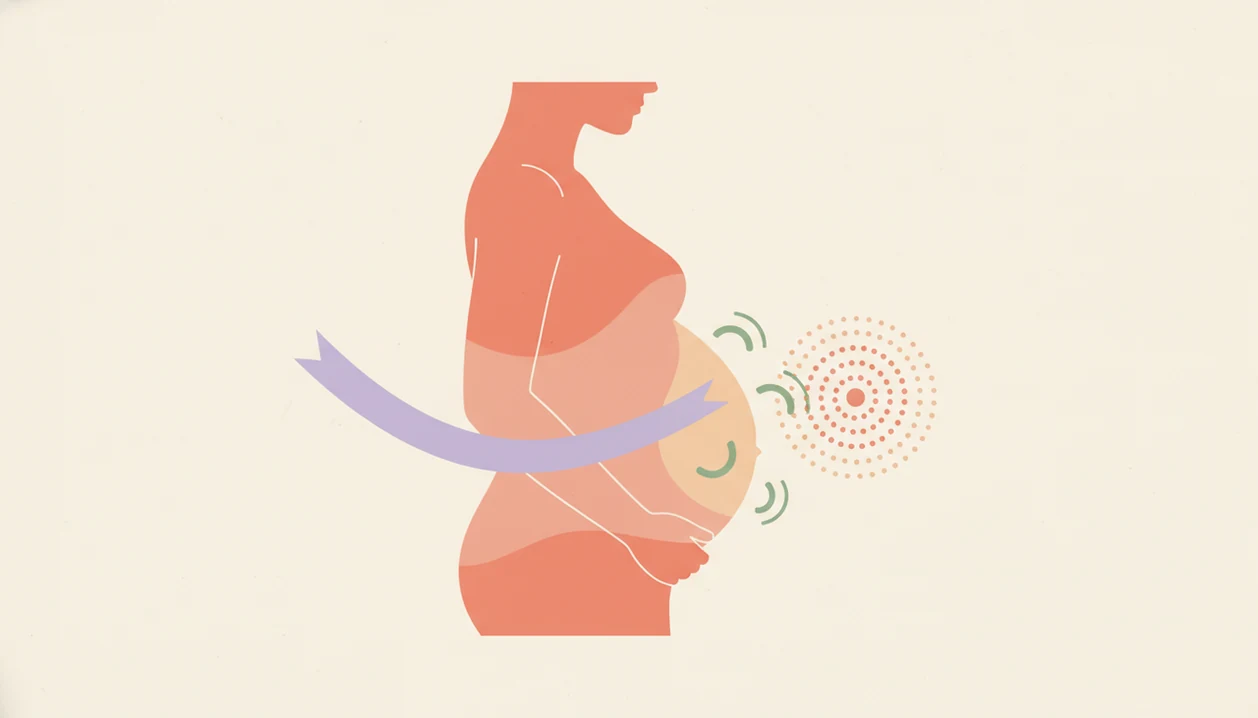
Yes, do rolls count as kicks is a common question, and rolls usually count during third-trimester kick counting when they are clear baby movements. Hiccups are the common exception, and any noticeable decrease or change in your baby’s usual movement pattern should be discussed with your healthcare provider.
This guide is general education for third-trimester movement awareness, not a diagnosis or a substitute for your own clinician’s instructions. If your clinic gave you a different kick-count threshold, use that threshold.
> In kick counting, a “kick” means one clear fetal movement you feel, including rolls and swishes, not only a sharp foot kick.
- Rolls, swishes, jabs, pokes, flutters, and pushes usually count as fetal movements during kick counts.
- Hiccups are typically not counted because they are involuntary rhythmic movements.
- The most important signal is a change from your baby’s normal pattern, not whether the movement felt like a kick or a roll.
Do rolls count as kicks in pregnancy kick counts?
Do rolls count as kicks in pregnancy kick counts? Rolls count as kicks when they are clear baby movements you can feel and separate from hiccups. Many medical and public health kick-count routines use “kick” as shorthand for fetal movement, not only a sharp foot jab.
That means a slow roll across one side, a swish low in the belly, or a push under the ribs can all be logged. Paper charts and apps usually treat these as one movement each when they are distinct. If your provider gave different instructions, follow those first.
The couch after dinner is often where this becomes obvious. A phone timer is open, the room is quiet, and the baby gives one long side shift instead of a kick. Count the movement if it is clear.
How baby rolls kick count tracking works
Baby rolls kick count tracking works by watching the baby’s usual movement pattern over time, not by diagnosing whether one movement is healthy or unhealthy. Rolls, swishes, stretches, and kicks are all observable signs of fetal activity.
Fetal movement awareness is pattern monitoring. In plain language, you are learning how long your baby usually takes to reach a movement benchmark during a daily kick count routine. Clinicians typically recommend contacting the care team when that familiar pattern suddenly changes.
How to use baby rolls kick count tracking:
- Choose a daily time when your baby is often active.
- Sit or lie where you can notice movement clearly.
- Count each distinct non-hiccup movement once.
- Stop when you reach the benchmark your provider recommended.
- Write down what changed if the session feels slower or weaker.
Tools like Baby Kicks App help pregnant people count kicks, track movement patterns, and know when to call their provider. A good fetal kick counter and pregnancy movement tracking app for third-trimester monitoring delivers organized logs and reminders, not a guarantee that everything is fine.
5 facts about swishes, rolls, and kick counts
These are the key facts for deciding what to count during a movement session. If you are unsure, your provider’s instructions should guide the final call.
- Swishes count when they are clear baby movements. A quick sweep, slide, or fluid-feeling shift can be logged if it is distinct.
- Rolls, jabs, pokes, flutters, and pushes also count. The label matters less than whether you felt one clear fetal movement.
- Hiccups are usually excluded. They often feel rhythmic, repeated, and evenly spaced, which is different from ordinary activity.
- Ten movements in up to 2 hours is a commonly cited benchmark. ACOG describes the count-to-10 method and notes that some clinicians advise calling if you do not feel 10 movements within 2 hours (https://www.acog.org/womens-health/faqs/special-tests-for-monitoring-fetal-well-being). Your provider’s threshold still comes first.
- A change from normal matters more than movement type. The most common medically supported way to use kick counts is to track all non-hiccup movements consistently and call your care team when the pattern changes.
That last point is the one we see missed most often in logs.
Baby rolls kick count examples that count
One distinct felt movement generally equals one count, whether it feels sharp, soft, low, high, fast, or slow. The full category is broader than the word “kick,” which is why what counts as fetal movement can be useful if you are building a routine.
- Slow side-to-side roll: A body shift that travels across the belly or presses along one side counts as one movement.
- Quick swish or sweep: A fast sliding sensation, almost like a fish turn, counts when it is clearly from the baby.
- Jab, poke, or punch-like movement: A sudden point of pressure is the classic kick-count movement.
- Clear flutter: A light flutter can count if you recognize it as fetal movement, especially earlier in tracking.
- Stretch or push: A firm outward pressure against the belly can count as one movement.
A printed movement chart in a folder may use boxes. An app may use a large tap button. The count is still the same idea.
Rolls, swishes, kicks, and hiccups compared
Most fetal movements count during kick counting, but hiccups are usually handled differently because they are rhythmic and involuntary. Use this table as a practical guide, then follow your provider’s instructions if they differ.
| Movement type | What it may feel like | Usually counts? | Practical note |
|---|---|---|---|
| Sharp kick | A quick jab or thump | Yes | Count one distinct kick as one movement. |
| Roll | A slow shift across the belly | Yes | A baby rolls kick count entry is valid when the roll is clear. |
| Swish | A sweep, slide, or swoop | Yes | Count it if you can tell it is baby movement. |
| Flutter | Light tapping or bubbling | Usually yes | More common earlier, but still countable if distinct. |
| Push | Firm pressure outward | Yes | Count the push when it starts as a separate movement. |
| Hiccups | Repeated, even pulses | Usually no | Hiccups are typically excluded from kick counts. |
For many people, should hiccups count as kicks is the only confusing exception. The rhythm is the clue.
When do rolls count as kicks near full term?
Near full term, rolls count as kicks when they are clear fetal movements, even if the baby feels less jabby than before. Movements may feel more like stretches, shifts, and slow body turns because the baby is larger and positioned differently.
The common phrase “the baby runs out of room” can be misleading. Movement may change in style, but the overall daily movement pattern should not drop sharply. You should still recognize your baby’s usual active times and typical pace.
Maybe the elbow drag along the left side replaces the tiny thumps you noticed at 29 weeks. That can be normal for your baby. But a noticeable slowdown, weaker pattern, or unusual change deserves a call to your provider, not a wait-and-see plan. If you are past 28 weeks, the step-by-step routine in how to count baby kicks after 28 weeks may help you keep the timing consistent.
Common myths about baby rolls kick count sessions
Several kick-count myths make people second-guess movements they should probably log. The safer routine is consistent tracking of all clear, non-hiccup movements.
- Myth: Only strong kicks count. Gentle rolls, swishes, pokes, and pushes can count when they are distinct fetal movements.
- Myth: Swishes are too vague to log. A clear swish counts if it is recognizable as baby movement and not gas, your pulse, or hiccups.
- Myth: Movement normally drops at the end of pregnancy. Movement style may change near term, but a clear overall decrease is not something to dismiss.
- Myth: Any rolling means there is nothing to worry about. A few rolls do not cancel out a slower, weaker, or unusual daily pattern.
- Myth: The exact movement type matters most. The pattern matters more than whether you wrote “kick,” “roll,” or “push.”
A 9 p.m. phone alert after brushing teeth can help keep the same time, same place habit. Simple beats clever here.
When to call your provider about kicks, rolls, or swishes
Call your provider right away for a sudden decrease, absence of movement, or meaningful change from your baby’s usual movement pattern. Do not wait until the next appointment if movement feels reduced.
Reduced or changed fetal movement is treated as a warning sign by public-health and obstetric guidance; NHS guidance says to contact maternity services immediately if your baby is moving less than usual or the pattern changes (https://www.nhs.uk/pregnancy/keeping-well/your-babys-movements/). Observational research also links reduced fetal movements with higher stillbirth risk (https://pubmed.ncbi.nlm.nih.gov/26113129/). Kick counts are a screening habit, not a diagnosis. Provider evaluation is the next step when something feels off.
Write down what changed before you call if you can: the time, how long you counted, what movements you felt, and what felt different. A folded kick count handout tucked into the hospital bag is useful, but it should not delay the call.
If you are unsure whether the change meets your clinic’s threshold, call anyway. The safety question is covered more directly in when to call doctor reduced fetal movement.
Medical sources and review process
This article uses obstetric and public-health sources to explain movement tracking, and it is meant to support—not replace—care from your own clinician. It has not been clinician-reviewed as of May 26, 2026.
The movement guidance is based on ACOG information about fetal wellbeing monitoring, NHS guidance on noticing and reporting baby movement changes, and stillbirth-research literature on reduced fetal movements as a warning sign. Those sources inform the practical message here: count clear non-hiccup movements consistently, notice your baby’s usual pattern, and call promptly when that pattern changes.
Our review process for this page is:
- Check current ACOG, NHS, and stillbirth-research guidance for movement-counting language.
- Compare the article’s thresholds and safety wording against those sources.
- Keep app and log descriptions limited to what they can do: organize timing, counts, and notes for a provider conversation.
- Avoid presenting movement logs as a diagnosis of fetal wellbeing.
- Update the article when major guidelines change, safety evidence shifts, or clinical language around reduced fetal movement is revised.
Limitations
Kick counting is useful, but it has limits. It should support conversations with your care team, not replace them.
- Kick counting is a screening tool, not a diagnostic test.
- A reassuring count does not guarantee that every pregnancy complication has been ruled out.
- There is no universal number of movements per hour that fits every baby, every pregnancy, and every time of day.
- An anterior placenta, body size, fetal position, and distraction can make subtle movements harder to feel.
- Apps rely on manual tapping and consistent timing, so data quality depends on the person using the log.
- Provider instructions may differ because of pregnancy risk factors, local protocols, gestational age, or previous concerns.
- A crumpled notebook page at the bottom of a purse can be hard to interpret later. Digital logs reduce that problem, but they still need accurate entries.
Digital fetal movement logs can organize movement sessions, but they cannot interpret fetal wellbeing. If the pattern feels wrong, call your care team.
FAQ
Do baby rolls count as kicks?
Yes. Baby rolls usually count as fetal movements during kick counts when they are clear and distinct.
Do swishes count as kicks?
Yes. Swishes count when they are clear baby movements and not hiccups or another body sensation.
Do hiccups count for kick counts?
Hiccups are typically excluded from kick counts. They usually feel rhythmic, repeated, and evenly spaced.
What movements count as kicks?
Kicks, rolls, swishes, jabs, pokes, flutters, stretches, and pushes usually count as fetal movements. Count one distinct felt movement at a time.
How many movements should I feel during a kick count?
Many third-trimester routines use 10 movements in up to 2 hours as a benchmark. Your provider may give different instructions based on your pregnancy.
Can my baby move less near the due date?
Movement may feel different near the due date, with more rolls and stretches. The overall pattern should not noticeably decrease.
When should I call my provider about baby movement?
Call your provider right away for reduced, absent, or unusual movement compared with your baby’s normal pattern. Do not wait for the next scheduled appointment.